Posts

Create a Great Funeral Day

“Funerals are the party no one wants to plan.”create a great funeral tombstone
So says Gail Rubin, a death services planner, radio host, and leader of the Albuquerque chapter of Death Café. She’s been called the Doyenne of Death and liked it so much, she trademarked it. She runs a site called A Good Goodbye – Funeral Planning for Those Who Don’t Plan to Die.

It’s appropriate, she says, that Create a Great Funeral Day comes right before Halloween and the Day of the Dead. “Before ghosts can go a-haunting and spirits of the deceased can be celebrated, someone’s gotta die.”

Countless movies and television shows have poked fun at the stress of eulogizing a complete stranger, but how much do we know about our loved ones? Enough to plan the party after they’re gone?

Create a Great Funeral Day

This holiday originated with Stephanie West Allen in 2000 after her mother-in-law died, leaving no instructions for her funeral. Watching her husband struggle to create a meaningful service inspired Allen to write Creating Your Own Funeral or Memorial Service: A Workbook to encourage people to pre-plan their funerals and spare their families that stress.

This book is invaluable in addressing the amount of work involved in organizing a funeral. Many people are unaware of the processes required, including collection, transfer, preparation, choice of cremation or burial, selection of a plot, niche, or home storage, and the type of urn that best suits one’s decor.

Go Wish (just not for more time)

Another, more playful planning tool is Go Wish, a card game developed as a fun way to start a conversation and clarify the end-of-life wishes of the targeted family member. If a relative shows up with this card game, he might know more than you do about your latest MRI results. And he might have his eye on your collection of mint-condition Life magazines.
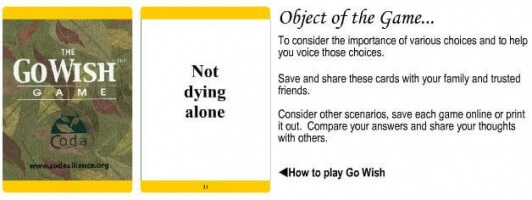
create a great funeral day go wish

The Go Wish game is a set of 36 cards and can be played by several people or in “solitaire” mode, which just sounds like the saddest thing ever.  Each card has a short statement that the individual (let’s just call him the goner) will rank in order of priority of what’s most important to him in his last weeks or months of life.  He can then explain to a possibly imaginary friend or family member why he sorted it the way he did.

The game’s maker, Coda Alliance, has tested the game in hospitals, nursing homes, community meetings, and elsewhere. A researcher stated, “In one large group, where I emphasized that we did need to collect the packs for re-use, there was nonetheless a 30% attrition rate – a testament to this being a desirable commodity.”  Or maybe nursing homes are a breeding ground for degenerate thieves.

Boomers are Doing it for Themselves

While Create a Great Funeral Day was not a big hit when it began, Allen says attitudes are changing, her book is getting less resistance, and its readership is growing. Why? “The boomers are doing it. The boomers are the do-it-yourselfers, they had their own way of doing anything, they did their own weddings, they’re going to do their own funerals, and that’s just now starting, so they’re going to have a huge impact.”

Boomers: Is the International Cemetery, Cremation and Funeral Association (ICCFA) pandering to you when its site sports a YouTube link to Blue Öyster Cult’s 1976 song, Don’t Fear the Reaper? Per ICCFA, the song’s message is that love endures beyond the grave despite the best efforts of the Grim Reaper, a personification of death from European folklore.  We thought it was just about getting stoned.

Pressing the Flesh

It isn’t surprising to learn that 38% of so-called Millennials and 32% of Gen-Xers have tattoos. But you may not have realized that increasing numbers of older people are getting inked, too. A Pew Research study found that roughly 15% of Baby Boomers—those born between 1946 and 1964—have at least one tattoo. (The results were published in 2010, and we haven’t found anything more recent. Perhaps it isn’t exactly catnip for grant money.)

So what happens to that tattoo when you die? Good news: you don’t have to take it with you! When you join Save My Ink Forever, you’ll have peace of mind knowing your tattoo will be harvested from your body within sixty hours of your death and treated with a proprietary blend of chemicals that halts decomposition.
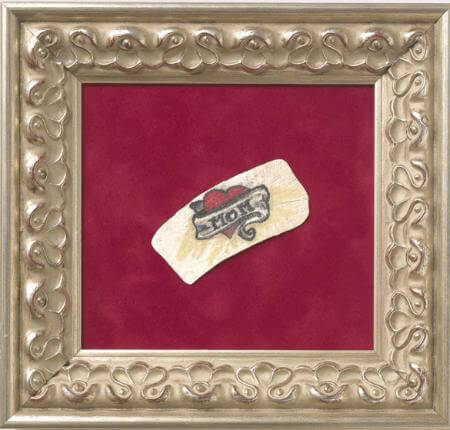
create a great funeral day tattoo

Yes, this is a real tattoo.

According to the company, this preservation process permanently alters the human canvas, or “raw art.” Then the finished piece, which is technically no longer skin and therefore not creepy at all, will be shipped to your lucky loved one. It now offers framing services as well. We’re guessing that local framing shops may have been squeamish about mounting said art.

If you’d like to leave your tattoos to that special someone, start saving your change now: preserving a full-body tattoo costs between $80,000 and $100,000. Does the price vary due to the donor’s, um, surface area? Will it arrive in a massive frame, or as a Barry-skin rug? (We know your name is probably not Barry, but it works for the pun. Please bear with us. Oops, did it again.)

Get Started!

Don’t wait another day to create a great funeral for yourself. Remember, if you build it, they will come. (Have we mentioned paid mourners? Can’t hurt!) Now get out there and have fun!

Sylvia Plath Day

Is it possible to wish someone a Happy Sylvia Plath Day? How can anyone celebrate the birthday of a woman who killed herself? Is this a joke? Is it sponsored by some brand of oven cleaner? We found evidence that this holiday exists:

From the Sylvia Plath Forum, created in 1998 by Elaine Connell and closed after her death in 2007:

To all avowed Sylvia Plath supporters and admirers:

I am with the Sylvia Plath day organizing committee. Let me explain: over 1,000 people signed a petition just recently in the city of Northampton, Ma to have a Sylvia Plath Day. The Mayor, consumed by the irresistible force of Plath petition signers/supporters then declared October 27, 2001 Sylvia Plath Day. As you know, Sylvia Plath attended Smith College in Northampton. We are planning a big celebration of the life and legacy of Sylvia Plath on October 27 of this year. We can use your help!

Michael
Northampton, Ma, USA
Friday, April 27, 2001

Unfortunately, we could find no Northampton public records to confirm the mayor was indeed “consumed by the irresistible force.” But if we still pore over her work and the minutiae of her life over fifty years after her death, does it matter if it’s official or not?

sylvia plath day

Published under a pseudonym

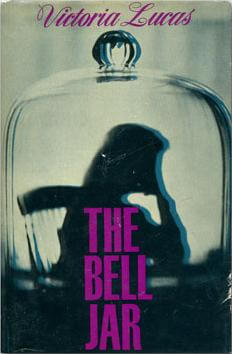
Of course, we remember Sylvia Plath because she wrote The Bell Jar, a novel that has been required reading for many in high school despite (mostly) unsuccessful attempts to ban it for its “overt rejection of the woman’s role as wife and mother.” And, like it or not, we remember her because she committed suicide. We study her poetry and prose, trying to divine what fueled her despair, what caused her to take her own life. Plath wrote this in her journal a few months before her death:

I feel outcast on a cold star, unable to feel anything but an awful helpless numbness. I look down into the warm, earthy world. Into a nest of lovers’ beds, baby cribs, meal tables, all the solid commerce of life in this earth, and feel apart, enclosed in a wall of glass.

Plath wrote poetry in a confessional style, revealing intimate details about herself. She was driven, publishing her first poem when she was eight. She was the first poet awarded a posthumous Pulitzer Prize. She wrote fifty short stories in addition to her one novel.

In February of 1963, her depression overcame her. For weeks, her doctor had tried to secure a bed for her in a psychiatric hospital. She sealed her children in their room upstairs, then sealed herself in the kitchen, put her head in the oven, and turned on the gas. She was thirty years old.

On Sylvia Plath Day, instead of fetishizing her death or lamenting the loss of all she might have written, we can celebrate her life by learning about her, reading her work, and being happy for what she shared with us in her short yet brilliant life.

It’s a day we should also acknowledge the brutal power of mental illness to damage and destroy lives.

Learn more at:
Neurotic Poets
This Day in History
Sylvia Plath and the Mythology of Women Readers: 2011, Univ. of Massachusetts Press

If you are thinking about suicide, read this first.

National Suicide Prevention Lifeline website and toll-free telephone number: 1 (800) 273-8255

RIP Visit a Cemetery Day

visit a cemetery day

Visit a Cemetery Day is supposed to take place on the last Sunday of October each year, but the unofficial holiday has vanished without a trace.

The inaugural event in 2010 was intended to create an annual ritual of remembrance, according to organizers, mysendoff.com, International Memorialization Supplier Organization (IMSA), Kates-Boylston Publications, and American Cemetery Magazine.

By 2012, the founders were so confident in their new tradition that they announced the next Visit a Cemetery Day a year in advance, yet there is no record of it taking place in 2013 or any year since. Where has it gone?

Perhaps it has been forgotten as the industry adjusts to an evolving marketplace. (Check out this TED Talk on the Infinity Burial Suit that uses embedded mushrooms to digest dead flesh and promote “an individual engagement with the process of decomposition.”)

In 2014, American Cemetery Magazine rebranded itself as American Cemetery and Cremation “to better connect with the expanding readership and better align with the changing dynamics in the death-care profession.”

Access the digital version here. Unfortunately, you can no longer order a print subscription through MortuaryMall.com, but you can still find disaster pouches (a.k.a. body bags), cremation pan cooling racks, and stainless steel body trays with and without drain holes. If Very Berry spray “neutralizes body decomp odors” as advertised, imagine what it could do for your litter box!

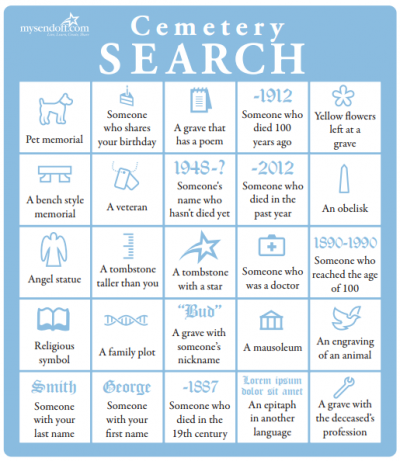
Perhaps the most compelling reason to resurrect Visit a Cemetery Day lies in the game introduced on mysendoff‘s Facebook page on October 25, 2012:

“For those of you who are planning to introduce children to “Visit a Cemetery Day” we created a Cemetery Search game that is easy to play. Just click on the image and print your own card(s). It’s a fun way to start finding out some of the history that can be found in your local cemetery.”

visit a cemetery day search card

Just in case Visit a Cemetery Day ever comes back from the dead, it may be a good idea to start the therapy fund for your kids now. It’s not a terrible thing for children to learn about death — but isn’t that what hamsters are for?

July 8 is the Soapy Smith Wake

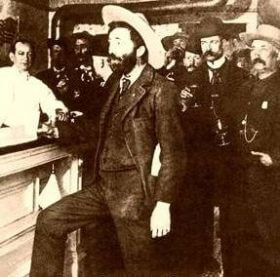
Today is the 43rd annual Soapy Smith Wake. Since 1974, descendants of con man Jefferson “Soapy” Smith have held an annual wake for him on the anniversary of his murder in Skagway, Alaska, on July 8, 1898.

soapy smith's wake

Soapy Smith, image at legendsofamerica

Jefferson Smith lived to prove the axiom, “A fool and his money are soon parted.” He gained his nickname due to his prize soap scam, in which he’d set up a display of soaps, make a show of placing bills from one to one hundred dollars around several bars, wrap them to resemble the other bars, then appear to hide them in the stack.

A shill he’d plant in the crowd would pay a dollar, unwrap a seemingly random soap, pull out a bill, and start shouting about his winnings. This convinced others to clamor to buy the other bars. There were no more winners. Smith had used sleight of hand of hand to conceal the fact that he had not put the money-wrapped bars in the pile. Halfway through, he announced the hundred-dollar bill hadn’t yet been found and auctioned off the remainder.

At some point in Smith’s mostly successful twenty-year career, Smith was arrested for running the prize soap racket. The police officer forgot Smith’s first name and wrote “Soapy Smith” in his logbook. The name stuck.

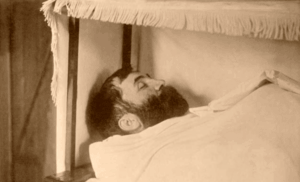
Smith’s luck came to an end on July 8, 1898, after his crew bilked a miner out of a sack of gold in a crooked game of three-card monte. Four men, including vigilante Frank H. Reid, confronted Smith, who refused to return the gold or turn over his associates. In the ensuing gunfight, Smith and Reid exchanged fire. Smith was shot through the heart and died instantly; Reid, shot in the groin, died twelve days later of his injuries.

Soapy Smith, dead, image at legendsofamerica

Soapy Smith was buried several yards outside the Skagway city cemetery. Over the years, his reputation grew to that of a Klondike-style Robin Hood, fleecing the rich to give to the poor. There’s no evidence he did anything but line his own pockets and those of the public servants and businessmen he bribed.

Reid was painted as a villain who murdered Smith. If we assume the two men shot each other—and there are those who question that—then Smith must have shot Reid first, since he couldn’t have fired after being shot through the heart. Unless the gun went off as he was falling, but then we’re getting into grassy knoll territory.

On July 8, 1974, members of Smith’s family and their friends began the tradition of holding a wake at his gravesite, toasting him with several bottles of champagne. When the group felt nature calling, they started another tradition by entering the cemetery proper and relieving themselves on Frank H. Reid’s grave.

A reporter present at the wake dubbed it the “sprinkling of Frank.” The Smiths and many residents found it humorous at the time. The family continued to furnish champagne for years until the wake was finally banned from the cemetery and moved to the Eagles Hall in downtown Skagway.

If you can’t make it to Skagway to celebrate, The Magic Castle in Hollywood, California, has held a Soapy Smith Party every year since 2004. No matter where you are, raise a glass, if you like, and toast the cantankerous, thieving criminal known as Soapy Smith. And if you have to pee, please use a restroom.