Posts

July 6 is Umbrella Cover Day
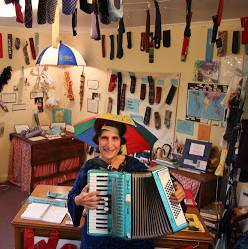
Umbrella Cover DayToday is Umbrella Cover Day. Although the holiday got its start in 2014, its roots reach back to 1996, when Maine native Nancy 3. Hoffman founded the Umbrella Cover Museum, with the motto “Celebrate the Mundane,” dedicating it to “finding wonder and beauty in the simplest of things.”

Hoffman changed her middle name from Arlene to Three in 1992 after a typographical error on a form gave her the idea; she likes that “3” is universal to every language and needs no translation. She heads up an accordion band known as The Maine Squeeze. Her one-woman performance of “The Mikado” by Gilbert and Sullivan was once produced at Scotland’s Edinburgh Fringe Festival.

Many years ago, Hoffman explained her inspiration for the museum in her book Uncovered and Exposed:

I was cleaning out my house one day, and discovered that I still had all of the covers from all the umbrellas I’d ever bought (Seven or so.) That got me thinking. Then one day, around 1992, I was in a dime store and I stole a cover off of an umbrella…just the cover. Then I knew I was hooked. After that I started planning the Museum and soliciting donations for the exhibits.

In 1996, the Umbrella Cover Museum opened its doors — more specifically, the door to her kitchen, where the covers were displayed. Eventually, the collection grew so large that she moved it to its current two-room location on Peaks Island, Maine.

The museum is open during the summer months. (Hoffman winters in Key West, Florida.) Guided tours are available. The curator/director serenades lucky visitors with her rendition of “Let a Smile Be Your Umbrella” while accompanying herself on accordion.

For several years, Hoffman petitioned the Guinness Book of World Records to add a new category for umbrella sleeves. Guinness finally acquiesced, scheduling an official count on July 7, 2012. News of the upcoming event brought donations from around the world.

By the day of the event, the museum housed covers hailing from forty-eight countries. According to Guinness rules, to attain a record for the highest number of an object, the total must exceed 500. Handmade covers and duplicates were not allowed in the tally. Hoffman sailed into the record books with 730. As of this writing, the museum has received over 2,000 covers from 71 countries.

Hoffman is always happy to accept umbrella covers and solicited monetary donations to fund a long-time goal to host a British “pop-up” museum.  For two weeks in September 2017, she exhibited over 300 covers at “Centrespace Gallery” in central Bristol. Why? Because, Hoffman said, “Where else would umbrella covers be more appreciated than England?” (No word on whether she’ll take them to the wettest places on Earth. Or Seattle.)

On a scale from “Honey, get the pitchfork” to “She’s not hurting anyone,” Hoffman occupies the “lovable eccentric” zone. Maybe we shouldn’t need her Umbrella Cover Museum to help us find “wonder and beauty in the simplest of things,” as she puts it. But don’t we?

Happy Umbrella Cover Day!
Share this:

Bikini Day

Today is Bikini Day. On July 5, 1946, French designer Louis Réard unveiled a two-piece swimsuit he named after a US atomic bomb test at Bikini Atoll in the Pacific Ocean, conducted only five days earlier. He believed his swimsuit would cause an “explosive commercial and cultural reaction.”

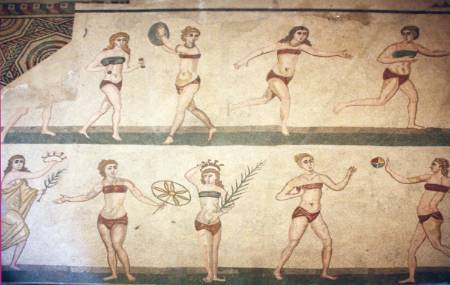
Two-piece outfits were not new. In 1960, while excavating the ruins of a fourth-century Roman villa, archaeologists discovered a mural depicting ten women, informally referred to as “the bikini girls.” There’s no evidence to suggest the clothing was used for swimming.

bikini day

Villa Romana del Casale – “the bikini girls”

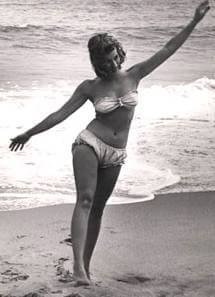
In the 1930s, European women began wearing two-piece bathing suits — a halter top and shorts — that bared a bit of midriff and covered the navel entirely. During World War II, fabric rationing led to similar designs in the U.S.

In 1946, Réard wasn’t the only French designer determined to capitalize on the jubilant postwar mood with fashion evoking an odd, bomb-loving nostalgia. Jacques Heim had designed a bathing suit in 1932, when exposing the belly button was still considered scandalous. He rereleased it in June 1946 with the name “Atome” in honor of the atomic bomb, and advertised it as “the world’s smallest bathing suit.”

bikini day

Jacques Heim’s “Atome”

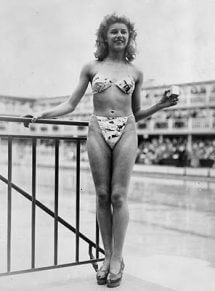
Réard’s swimsuit was smaller, constructed of a little bra top, two triangular pieces of fabric, and string. He planned to unveil it three weeks later, on July 5th at the Piscine Molitor pool, promoting it as “smaller than the world’s smallest bathing suit.”

One issue threatened to derail Réard’s plan: He couldn’t find a professional model who would agree to wear the skimpy bikini. His solution turned out to be a stroke of marketing genius. He hired exotic dancer Micheline Bernardini, who had no problem with appearing nearly nude in public.

bikini day

Réard’s “bikini”

To demonstrate his confidence in the headlines his bikini would generate, he printed newspaper-style text across the suit’s material. The bikini was a hit, and so was Bernardini, who reportedly received 50,000 fan letters.

In less than ten years, the bikini became a familiar sight on beaches all over Europe. By the 1960s, it was popping up everywhere in the U.S. as well. Seventy years after its introduction, the design continues to dominate the market. Réard summed up its sexy allure when he stated:

“A bikini is not a bikini unless it can be pulled through a wedding ring.”

Happy Bikini Day!

Share this:

June 16 is Ladies’ Day

ladies' day

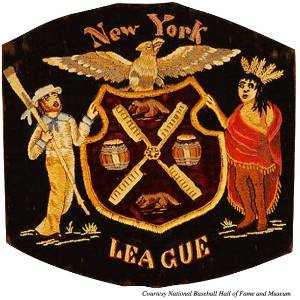
It’s a good thing they changed the logo.

Today is Ladies’ Day, originally devised to attract women to baseball games and convert them into fans. In actuality, it was designed to sell more tickets by getting men to bring their wives and, by extension, their children to games. (While women wouldn’t win the right to cast a ballot for nearly 40 years, we hope they got a vote in this case.)

The New York Gothams’ management held the first Ladies’ Day on Tuesday, June 16, 1883, at the Polo Grounds in Manhattan. All women, both escorted and unescorted, were admitted free of charge. This was quite progressive for the time, since unescorted women were considered “loose” or “of ill repute.” The Gothams beat the Cleveland Spiders 5-2 that day. (The team later changed its name to the New York Giants.)

Ladies’ Day proved so popular that it became a weekly tradition for many ball clubs. As more women began to fill the grandstands, baseball games gradually evolved into a more family-oriented affair. Never underestimate the power of marketing to change the world.

Happy Ladies’ Day to one and all!

Share this:

June 8 is Hannah Duston Day

Today is Hannah Duston Day. On June 8, 1697, she became the first official heroine of the American colonies when her husband was awarded the sum of 25 pounds in her honor. As a woman, she was technically her husband’s property and had no right to collect the money herself, but we suppose it’s the thought that counts.

On March 16, 1697, Hannah, her infant daughter, and a nursemaid named Mary Neff were kidnapped from her home in Haverhill, Massachusetts, by a band of Abenaki “Indians.” Native Americans had been incorrectly labeled “Indians” by Christopher Columbus two centuries earlier when, due to a navigational error, he landed in the Antilles but named its indigenous people after the Indian Ocean he thought he’d reached. He was off by over 10,000 nautical miles.

Hannah and Mary were forced to march north with at least ten other hostages. Early on, the baby was pulled from Hannah’s arms and killed. For six weeks, they trudged along; those who couldn’t keep up were murdered.

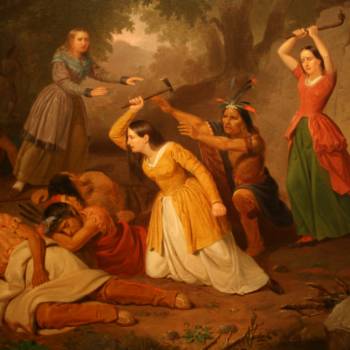
On April 29, they stopped for the night in Boscawen, New Hampshire. While the Abenakis slept, Hannah and other prisoners killed ten of them, including six children, scalped each one, then escaped back to Haverhill.

hannah duston day

After returning home, she traveled with her husband to Boston, where she told her story to Cotton Mather, a Puritan minister who wrote it down and went on to recount it to rapt congregations throughout the colonies.

Their trip had another purpose. Hannah had intended to collect the bounty offered for each scalp she’d taken, not realizing that the state-sponsored payment program had expired. She and her husband delivered a petition to the Massachusetts General Court requesting a reward for “the just slaughter of so many of the Barbarians, as would by the law of the Province which [existed] a few months ago, have entitled the actors unto considerable recompense from the Publick.”

As a result, the court awarded Mr. Duston the sum of 25 pounds. It would seem we have now come full circle. In fact, we have arguably dismantled this holiday. But there is still more to be told.

As Mather’s sermon was rewritten and retold, it began to change; the murder of sleeping children was de-emphasized or dropped. By the 19th century, the doctrine of manifest destiny held that the expansion of the U.S. was virtuous, inevitable and directed by God, providing justification for such morally bankrupt acts as “Indian removal.”

Author Henry David Thoreau and poet John Greenleaf Whittier, among other storytellers of the era, seized upon Hannah Duston’s account, casting her as a quintessentially American heroine.

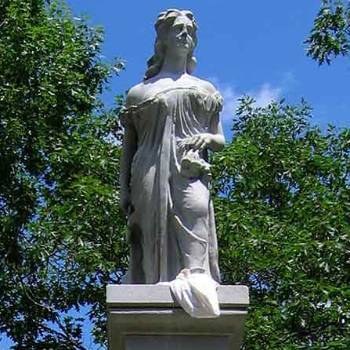
In 1874, a statue was erected on the island of Boscawen, New Hampshire, the first US monument to honor a woman. In her right hand, she holds a hatchet; in the left, a bunch of scalps.

hannah duston day

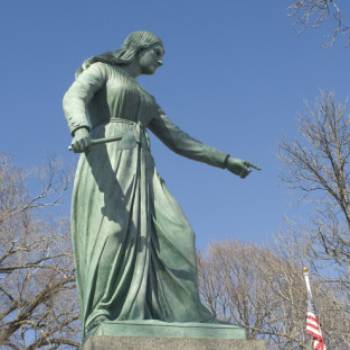
Not to be outdone, the city of Haverhill, Massachusetts, erected a monument of its own in 1879. Although Duston holds no scalps, she brandishes a hatchet while pointing toward the ground. (Is she choosing the next sleeping person to kill and scalp?)

hannah duston day

Unsurprisingly, the statues are the subject of controversy, but for now, they still stand. The one in Boscawen is a bit worse for wear—someone shot off her nose.

hannah duston day

Image: vcnaa.com

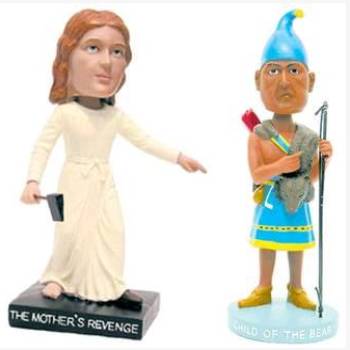
The New Hampshire Historical Society discontinued the sale of its Hannah Duston bobblehead after coming under harsh criticism in late 2014. But it’s still selling its limited edition bobblehead of Chief Passaconaway, the 17th-century English settler-loving sachem of the Penacook tribe.

While Hannah Duston Day is certainly an uncomfortable reminder of our nation’s history, perhaps it can also shine a light on the rationalization of prejudice and help us confront and defeat the glorification of hatred.

[Note: Records use several different spellings of Duston, including Dustin, Dustan, and Durstan. For the sake of uniformity and because it’s the spelling used on both monuments, we have chosen to use Duston.]

Share this: