Posts

Test Tube Baby Day

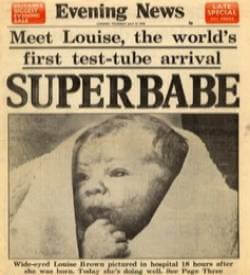
test tube baby dayToday is Test Tube Baby Day. On July 25, 1978, in Oldham, England, Louise Joy Brown became the first person born after being conceived outside her mother’s body, in a revolutionary process now called in vitro fertilization, or IVF.


In IVF, egg and sperm are placed together in a liquid with some smooth jazz and Bacardi 151; after the egg has been fertilized, it is transplanted into a woman’s uterus. (We’re kidding about some of that.)

The media’s description of Louise as a “test tube baby,” evocative of heretical work performed by mad scientists, was widely adopted but technically inaccurate. Her conception took place in a petri dish.

At the time, her parents knew the procedure was experimental but were unaware that it had never resulted in a baby. This raised questions about their ability to give informed consent and the ethics and motives of the doctors involved. Disciplinary action might have been taken had Louise not been born.

IVF has become an accepted treatment for infertility, notwithstanding its recent use as a political football. In 2010, Robert Edwards, one of its developers, received the Nobel Prize in Medicine. By 2018, more than 8 million children had been conceived through the process.

Happy birthday, Louise!

Amelia Earhart Day

Amelia Earhart Day

image – history.com [since scrubbed from site]

Today is Amelia Earhart Day, celebrating the aviation pioneer’s birth on July 24, 1897.  In 1932, she became the first woman to fly solo across the Atlantic, for which she received the U.S. Distinguished Flying Cross. A member of the National Woman’s Party and an early proponent of the Equal Rights Amendment, Earhart’s self-confidence and spirit of adventure made her an inspiration to young women.

Earhart vanished without a trace on July 2, 1937, during her attempt to circumnavigate the globe. Despite the likelihood that the plane was never found because it crashed into the Pacific Ocean and sank, theories about her disappearance persist to this day, running the gamut from midair abduction by aliens to a secret move to New Jersey to live under an assumed name.

One popular hypothesis claims the Japanese captured Amelia Earhart and her navigator, Fred Noonan, torturing and executing them or holding them in secret for the rest of their lives. Some claim Earhart was a spy for the U.S. Others say she was one of many English-speaking women forced to make radio broadcasts as Tokyo Rose, although propagandists wishing to demoralize American servicemen surely would have seen the benefit in using her real name.

On July 9, 2017, the History Channel aired “Amelia Earhart: The Lost Evidence,” featuring a photograph that showed two Caucasian people on a dock at Jaluit Atoll, with a vessel carrying something that resembled plane wreckage in the background.

A military history blogger scouring archival images soon found the photo had been taken in 1935, two years before the crash. This revelation called into question the veracity of the entire documentary. The cable channel has since canceled reruns and deleted streaming video of its program. It also released this statement:

“HISTORY has a team of investigators exploring the latest developments about Amelia Earhart and we will be transparent in our findings. Ultimately, historical accuracy is most important to us and our viewers.”

As of July 2025, I have been unable to find any information regarding the conclusion of the investigation. Please let me know if you’ve seen any so I can update this post.

No matter the truth of her death, we should all celebrate the life and accomplishments of this extraordinary woman.

Happy Amelia Earhart Day!

Gorgeous Grandma Day

Gorgeous Grandma DayToday is Gorgeous Grandma Day, created by author Alice Solomon. After graduating from Wellesley College in 1984, at age 50, she felt she and her generation had been written off and branded “senior citizens” by society.

Solomon believed this occurred the moment she hit the half-century mark. “In an instant and only one day older, I was thought of as over the hill, no longer sharp, strong, vital, useful, sexy, hip, interesting, or worthy of hiring; in other words finished, kaput,” she explained in a 2007 interview. The concept of Gorgeous Grandma was born.

For months, I tried to think of a name for our group, one that would be upbeat, fun, catchy and grab attention. Finally, ‘gorgeous’ was selected because it presents a snappy, ‘notice me’ image, while ‘Grandma’ instantly defines an age group and stage of life regardless of whether a woman is actually a grandmother.

Using that definition, Solomon created Gorgeous Grandma Day to celebrate women over 40. She wrote two books on the subject, became a motivational speaker, a part-time radio host and launched Gorgeous Grandma Communications in West Palm Beach, Florida.

Nowadays it’s hard to imagine labeling any 50-year-old as a senior citizen. For that matter, the term “senior citizen” no longer carries the stigma it once had. Thanks to Alice Solomon and many other women like her, today’s generation doesn’t have to worry about that.

Have a happy Gorgeous Grandma Day! (You know who you are.)

Copyright © 2017 Worldwide Weird Holidays

Nettie Stevens Day

nettie stevens day

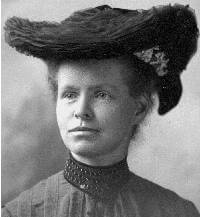
Nettie Stevens

Nettie Stevens Day celebrates the scientist who discovered XX and XY chromosomes determine sex. But few know of her contributions because the credit went to a man — who got it wrong.

Nettie Stevens studied mealworms and found that a male’s sperm carried both X and Y chromosomes, while a female’s eggs contained only X chromosomes. She concluded that sex determination must come from fertilization of the egg by the sperm. In 1905, she submitted a paper for publication, reporting her results.

Meanwhile, Columbia University scientist Edmund Beecher Wilson had reached the same conclusion, sort of. He was asked to review Stevens’ paper prior to its publication; his own paper had reportedly already gone to press, negating any possibility of dishonesty.

Historian Stephen Brush disputes the timeline in The History of Science Society: “It is generally stated that E. B. Wilson obtained the same results as Stevens, at the same time,” he writes. But “Wilson probably did not arrive at his conclusion on sex determination until after he had seen Stevens’ results.”

In fact, Wilson wrongly asserted that environmental factors could influence sex. Stevens insisted it was all due to chromosomes. At the time, there was no way to prove either theory. However, it has been known for decades that Stevens got it right. That should render the question of who published first irrelevant.

In spite of that, Wilson and Stevens were credited with making the fully correct discovery independently.  Wilson received the lion’s share of accolades while Stevens was often mistakenly referred to as a “lab technician.”  Brush states, “Because of Wilson’s more substantial contributions in other areas, he tends to be given most of the credit for this discovery.”

The fact that Nettie Stevens had two X chromosomes certainly contributed to the lack of recognition. Her own accomplishments refute Brush’s assertion. She published 40 papers and was about to attain full research status at Bryn Mawr when she died of breast cancer on May 4, 1912, at the age of 50.

She — and Wilson, too — have been all but forgotten since then. In 1933, fellow scientist Thomas H. Morgan received the Nobel Prize for his pioneering work in chromosomal research, even though he didn’t espouse the theory until years after Stevens and Wilson had published their papers.

Stevens once remarked to her students that their questions were always welcome “so long as I keep my enthusiasm for biology; and that, I hope, will be as long as I live.”

Let’s remember Nettie Stevens today. And tomorrow and the next day….