Posts

Ice Cream for Breakfast Day

ice cream for breakfast dayToday is Ice Cream for Breakfast Day, a holiday invented in 1966 by a mother desperate to amuse her children while they were snowed in during a blizzard in Rochester, NY. Unsurprisingly, it was a hit. Since then, its popularity has grown exponentially, circling the globe.

As Florence Rappaport explained to the Washington Post in 2004, “It was cold and snowy and the kids were complaining that it was too cold to do anything. So I just said, ‘Let’s have ice cream for breakfast.'” The next year, they reminded her of the day and the tradition was born.

When her kids grew up, they continued to celebrate with parties at college and word of the holiday spread. Later, their children carried the message while traveling the world. Since then, Eat Ice Cream for Breakfast Day has been observed in Canada, Peru, Switzerland and Costa Rica.

In 2009, it was featured in the Chinese edition of Cosmopolitan magazine. Israeli newspaper Haaretz reported on it, first in Hebrew in 2013, then in English in 2014. No matter where it occurs, the holiday’s rules are simple.

  1. Eat ice cream
  2. For breakfast
  3. On the first Saturday in February

If you still need inspiration, consider this quote from playwright Thornton Wilder:

My advice to you is not to inquire why or whither, but just enjoy your ice cream while it’s on your plate.

What are you waiting for? Grab a spoon and eat ice cream for breakfast! (Have we mentioned that it’s always breakfast time somewhere and even McDonald’s serves breakfast all day? Breakfast is whenever you decide it is!)

Happy Ice Cream for Breakfast Day!

Copyright © 2017 Worldwide Weird Holidays

February 4 is Liberace Day

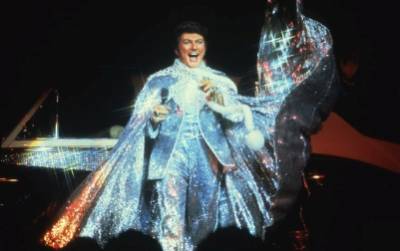
Today is Liberace Day. It commemorates the death of Władziu Valentino Liberace (May 16, 1919 – February 4, 1987), the American pianist, singer and entertainer known as Mr. Showmanship.

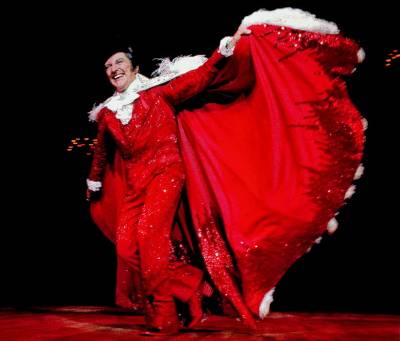
He had begun playing piano at four years old and by the age of thirty became the highest-paid entertainer in the world, touring internationally, releasing albums, appearing in movies and on television and doing lucrative product endorsements.liberace dayLiberace won two Emmy Awards, earned six gold albums and received two stars on the Hollywood Walk of Fame. He released an autobiography and set box-office records at Radio City Music Hall for 56 shows he performed only a few months before his death. His stage costumes, pianos, cars and homes were flashy paeans to excess. “Too much of a good thing is wonderful” became his motto.

His flamboyance fueled gossip and speculation about his sexual orientation. Liberace publicly denied his homosexuality, giving interviews about his ideal woman and appearing with Maureen O’Hara, Mae West, Judy Garland and others to give the impression of romantic involvement. Betty White spoke in 2011 about being set up by his manager to attend premieres as Liberace’s date, knowing full well that he was gay.

liberace dayThe women acted as “beards,” helping to conceal the performer’s homosexuality. It was a necessity in those days to avoid scandal. Until very recently, it was unheard of to “come out” without risking the destruction of one’s career. A leading man would lose his female fanbase, be branded a pervert and never work again.

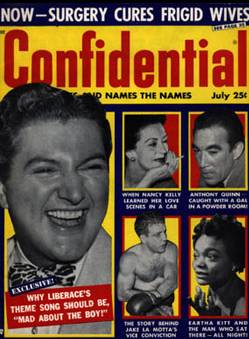
Liberace appeared to be an easy target. But when gossip rag Confidential and newspaper Daily Mirror ran hateful articles about Liberace’s relationships with men, he sued them and won. Although he was fighting to stay closeted, he was also fighting for everyone’s dignity and right to privacy. He may not have known it, but he was battling against the expressions of homophobia considered acceptable in the press and life in general.liberace day

Rumors circulated for years that he had HIV. After his death on February 4, 1987, his physician claimed he had died of heart failure due to degenerative brain disease.  Two days later, the request for a routine burial permit was rejected by the Riverside County coroner’s office, and his body was ordered to be delivered for an autopsy.

According to California law, anyone suspected to have died of a contagious disease should be autopsied. Had this law been followed rigorously, the coroner would have been working non-stop dissecting anyone who’d died with the sniffles. How Władziu Valentino Liberace presented a public health hazard at that point is unclear. He’d already been embalmed.

Tests concluded that Liberace had died of cytomegalovirus pneumonia due to AIDS. His depressed immune system couldn’t fight the illness. Was the autopsy necessary? Was it done for spite, to tarnish the reputation of a dead man? Was it done because of the fear of AIDS, or prejudice against gay men? Was it done to right the wrong of a physician falsifying a death certificate? Or all of the above?liberace day

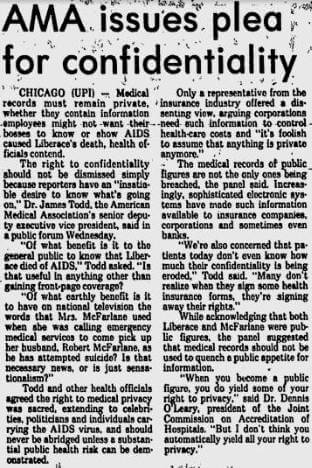
In reaction to media frenzy, the American Medical Association called for the confidentiality of all patient records. In any case, Liberace the man was beyond humiliation at that point. His body was returned to Forest Lawn Cemetery, where he was buried beside his parents. He bequeathed the bulk of his estate to the Liberace Foundation, which preserves a collection of his costumes and provides scholarships for students of the creative and performing arts.

Many of us got our first glimpse of fabulosity when we watched him as kids, before we knew what “gay” was. He was a talented and funny showman, completely at home in rhinestones and sequins, who seemed to be thoroughly enjoying himself at all times. If you’ve never seen him play, check out his reinterpretation of Mack the Knife and check out this short compilation from Time:

Happy Liberace Day!

Copyright © 2017 Worldwide Weird Holidays

February 3 is the Day the Music Died

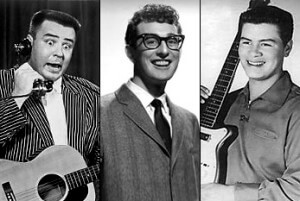
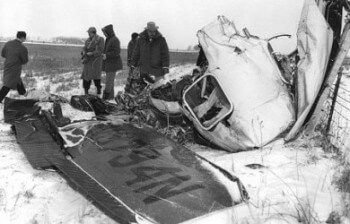
On February 3, 1959, musicians Buddy Holly, Ritchie Valens, and J. P. “The Big Bopper” Richardson were killed when their plane crashed in an Iowa cornfield. The tragic accident became known as “The Day the Music Died,” after a lyric in singer-songwriter Don McLean‘s 1971 anthem American Pie.
the day the music died

Richardson, Holly and Valens

At the time, they were on their way to a gig in Moorland, MN, a stop on their “Winter Dance Party” tour of the Midwest. Waylon Jennings, Tommy Allsup, and Dion DiMucci were on the way there on a school bus.

The tour began in Milwaukee, WI, on January 23, 1959. The first tour bus they rented was unequipped for the freezing winter weather. Due to the long distances between venues, everyone was stuck on the bus for many hours at a time.

The heater on the bus broke down. Drummer Carl Bunch suffered frostbite on his feet and was hospitalized in Ironwood, MI. The tour bus was replaced with a school bus and Bunch was left behind. Holly, Valens, and DiMucci took turns playing drums for each other at the performances in Green Bay, WI, and Clear Lake, IA.

By the time they reached Clear Lake on the evening of February 2, Holly was frustrated and decided to charter a plane to take him to Fargo, ND, after the show. The bus could then pick him up for the performance in nearby Moorhead, MN, sparing him hours of misery and allowing him to get some rest.

The four-seat Beechcraft 35 Bonanza Holly chartered was not named American Pie as many surmised from McLean’s song. It was known only by its registration number, N3794N. Except for a change in DiMuccio’s recollection timed to his book release more than 50 years later, the other survivors have always agreed on how the two remaining passengers ended up on that fateful flight.

The seats were meant for Holly’s bandmates Jennings and Allsup.  Along with Carl Bunch, they had formed a group after Holly left his band The Crickets. Holly felt responsible for convincing them to come on this miserable trip. Valens asked Allsup for his seat on the plane. He initially refused before agreeing to a coin toss to determine who would fly and who would take the dreaded bus. Valens won. Richardson had the flu so Jennings gave up his seat.

In Waylon: An Autobiography, Jennings related the conversation that would haunt him for the rest of his life. When Holly learned he wouldn’t be coming along on the flight,  he jokingly said, “Well, I hope your ol’ bus freezes up.” Jennings replied, “Well, I hope your ol’ plane crashes.”
day the music died

The cause of the crash has been under investigation on and off ever since. It was initially blamed on the poor judgment of the 21-year-old pilot, who was not yet qualified to fly using instrumentation in conditions of poor visibility. But it was also found that warnings about worsening weather weren’t relayed to the pilot before he took off in light snow.

In early 2015, the National Transportation Safety Board (NTSB) was petitioned to reopen the case and look for evidence of mechanical failure as well as proof that the pilot had made a heroic attempt to land. (The latter is unlikely as the plane hit nose down at 170 miles per hour.) In May 2015, the NTSB announced it will not reopen the case.

It’s a somber occasion to remember the death of these rock and roll legends but also an opportunity to celebrate the music they brought into the world. Listen to some of their hits today. It’s one way to keep the music alive.


Copyright © 2017 Worldwide Weird Holidays

January 31 is Scotch Tape Day

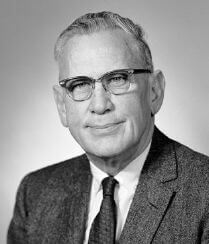
Today is Scotch Tape Day and celebrates the invention of cellophane tape in 1930. The story begins in the early 1920s at Minnesota Mining and Manufacturing, now known as 3M, which made only sandpaper at the time. Richard Gurley Drew, a banjo-playing college dropout hired as a research assistant, soon changed the course of the company’s history.

scotch tape dayWhile delivering sandpaper samples to an auto body shop, Drew noticed painters’ frustration with the tape they used to mask car parts. Overly sticky, it ripped off bits of paint when removed, ruining the detail and forcing them to start over. He made it his goal to find a solution to their problem.

For the next few years, Drew experimented until he found the perfect combination of treated crêpe paper, cabinetmaker’s glue and glycerin. It adhered well yet stripped off easily without taking paint with it when removed. Automakers immediately recognized its value and began placing orders for it. The tape was marketed as Scotch Masking Tape in 1925.

Drew rose quickly through the ranks.  In 1929, he struck upon the idea of using DuPont’s recently invented cellophane to make transparent tape. Cellophane was a moisture-proof material used to wrap and present baked goods and grocery items. Its only drawback was the difficulty of sealing packages securely and attractively. Drew hoped to develop tape that would blend with the wrap.

The machinery used to apply adhesive to masking tape was ill-equipped to deal with cellophane, which curled and ripped. The amber glue used on masking tape looked terrible on a transparent surface. Drew and his team had to design new machines and a new clear adhesive made from a combination of oil, rubber and resins.

scotch tape day

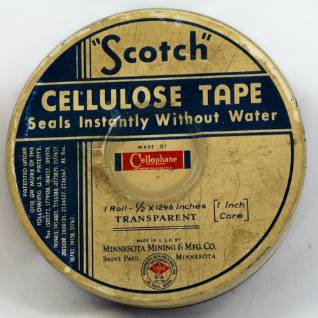
The resulting Scotch Cellulose Tape was introduced in 1930. By that time, DuPont had already developed a new type of cellophane that could be sealed with heat, negating the need for tape. Despite the fact that Drew’s invention missed its target market and debuted during the Great Depression, the adhesive tape sold well to thrifty customers.

In fact, the desperate times may have spelled success for Scotch tape when other products would have failed. Even the racial slur the name is supposedly based on may have helped boost its sales. Scottish people were considered stingy. It was an ethnic stereotype that served 3M well: when money is scarce, stinginess is a virtue and a “cheap” product is a smart buy.

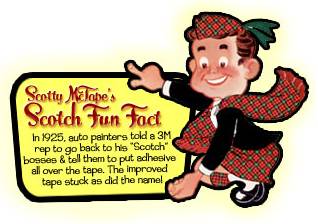
3M later promoted the legend with ads featuring “Scotty McTape,” a cartoon mascot who repeated the story that in 1925, auto painters told a 3M rep (presumably Drew) to go back to his “Scotch” bosses and tell them to put adhesive all over the tape. That’s unlikely since 3M didn’t make tape at the time and, in any case, the problem for the painters was that the adhesive was too strong.scotch tape day

Soon Scotty McTape was declared a member of Clan Wallace and began wearing its red tartan (and Wallace Hunting green plaid.) In the early 1970s, it was decided that McTape was no longer an effective marketing tool and the character was retired. The casual racism of Scotch tape’s name has been forgotten. Dispensers decorated in plaid are purchased every day with no awareness of their association with the clan of William Wallace, also known as Braveheart.

Richard Drew died in 1980 and was posthumously inducted into the Inventors Hall of Fame for U.S. patent number 1,760,820. While working for a sandpaper manufacturer, he invented a tool that has become an essential part of our lives. The next time you reach for adhesive tape, at home or the office, take a moment to imagine life without it. We can’t but, thanks to Mr. Drew, we don’t have to.

Happy Scotch Tape Day!

Copyright © 2017 Worldwide Weird Holidays