Posts

June 7 is VCR Day

vcr day

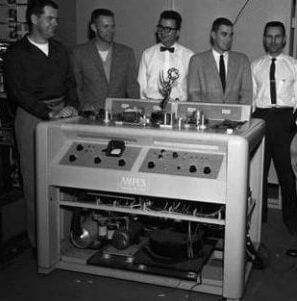
Ampex VRX-1000, 1956

Today is VCR Day. It commemorates the date in 1975 when Sony Corporation supposedly released the Betamax videocassette recorder (VCR) made specifically for home use. Some historians place the release in November 1975. In any case, it beat JVC’s Video Home System (VHS) to market by a year.

A VCR records the analog audio and video of a television broadcast or other signal source onto a removable, magnetic tape videocassette for subsequent playback. A programmable timer allows the user to schedule the recording to initiate, run, and conclude while unattended. It can also play back prerecorded tapes.

The history of the VCR dates back to the Ampex VRX-1000, which was released in 1956. Due to its substantial size and prohibitive cost of $50,000, it was affordable only to television networks and the largest individual stations. Toshiba, Philips, and RCA joined the fray; Sony partnered with Ampex for a while to share technology.

In 1965, Sony introduced the reel-to-reel type CV-2000, which stands for Consumer Video, as its first home-use model. (One ad shows the price as $695.) Despite Sony’s marketing efforts, it was primarily used for medical and industrial applications. Companies jockeyed for position for another decade.

There are many theories about why Sony won the battle to beat JVC to market in 1975, only to lose the war. One irrefutable fact is that each videocassette format was compatible only with its own VCR, ensuring that VHS and Betamax would never be able to play nice.

Sony may have gambled on its customers’ desire for quality over quantity, offering higher-definition tapes that could only record up to one hour of programming. While we value that today, it was much less of a selling point in 1975, when simply being able to record a show and watch it was more of a priority than being able to parse every speck of dust on M*A*S*H in hallucinatory detail.

When JVC released its VCR a year later, it used VHS tapes that held two hours. By the time Sony caught up, it was too late. VHS had become the standard. In 1981, Betamax had only a 25% market share. By 1986, it had dropped to 7.5% and continued to decline. Although it began selling VHS recorders in 1988, Sony continued to manufacture Betamax recorders until 2002 and only stopped producing Betamax tapes as of March 2016.

Of course, VHS didn’t stay on top forever. JVC stopped manufacturing standalone VCRs in 2008, long after DVD and Blu-Ray players had supplanted them. Streaming services put another nail in the VCR’s coffin.

Can a direct neural interface be far behind? As long as it doesn’t require the skull drilling we see in science fiction movies and the monthly fee is good, we say bring it on!

Until then, let’s celebrate our technological past and have a happy VCR Day!

Share this:

May 9 is Vast Wasteland Day

vast wasteland dayToday is Vast Wasteland Day. On May 9, 1961, Federal Communications Commission (FCC) Chair Newton Norman Minow gave a speech at the National Association of Broadcasters convention, chastising television programmers for their failure to serve the public interest.
First, a little backstory on Mr. Minow is in order. He was born in Milwaukee, WI, on January 17, 1926. He served in the U.S. Army during World War II, earned a law degree in 1950, then spent a year as a clerk for U.S. Supreme Court Chief Justice Fred M. Vinson.

The following year, he was hired by Adlai Stevenson, worked on the Illinois governor’s two presidential campaigns, and became a partner in his law firm. He campaigned for John F. Kennedy before the 1960 election. In 1961, President Kennedy appointed Minow as the chair of the FCC.

Now we’re caught up to May 9, 1961, when he said this:

When television is good, nothing — not the theater, not the magazines or newspapers — nothing is better. But when television is bad, nothing is worse. I invite each of you to sit down in front of your television set when your station goes on the air and stay there for a day without a book, without a magazine, without a newspaper, without a profit and loss sheet or a rating book to distract you. Keep your eyes glued to that set until the station signs off. I can assure you that what you will observe is a vast wasteland.

You will see a procession of game shows, formula comedies about totally unbelievable families, blood and thunder, mayhem, violence, sadism, murder, western bad men, western good men, private eyes, gangsters, more violence, and cartoons. And endlessly, commercials — many screaming, cajoling, and offending. And most of all, boredom. True, you’ll see a few things you will enjoy. But they will be very, very few. And if you think I exaggerate, I only ask you to try it.

The dated reference to stations signing off will be familiar to anyone old enough to remember the image of an American flag billowing to the strains of the national anthem, followed by a test pattern or color bars. Or to those who woke up on the couch to the sound of static, bathed in the glow of the spooky, Poltergeist-y snow that instantly made you feel there was someone waiting in the shadows, brandishing an axe.

Other than that, the speech could be given today. It would probably be met with a resounding, “So what?” rather than the ire that occurred in 1961. It was considered by many to be an elitist attack on programmers and viewers who enjoyed lowbrow or escapist fare.

Fun Fact: The writers of the 1964-1967 TV series Gilligan’s Island named the tour boat that ran aground the S.S. Minnow as a sarcastic reference to his name.

Minow doesn’t seem to mind. When asked in an interview by NPR what he considered his most valuable contribution, he mentioned convincing Congress to pass laws that paved the way for communications satellites. He recalled telling President Kennedy, “Communications satellites will be much more important than sending man into space, because they will send ideas into space. Ideas last longer than men.”

Until his death at 97 on May 6, 2023, nearly 62 years to the day after his “vast wasteland” speech, Minow still influenced communications-related law as senior counsel at Chicago-based law firm Sidley Austin LLP.  In 1988, he recruited Barack Obama to work there as a summer associate, where he met his future wife, Michelle Robinson. He supported Obama’s campaign for the presidency and for reelection.

He received 12 honorary degrees, sat on too many boards to mention here, wrote four books, funded Sesame Street, and co-sponsored the Digital Promise Project, which uses the Internet to further education. He also served as Honorary Consul General of the Republic of Singapore.

If we’d gotten the chance to meet Mr. Minow, we would have been sorely tempted to ask him a question solely to see his reaction. Imagine his facial expression if we’d asked what he thought of the Kardashians?

Share this:

April 5 is First Contact Day

First Contact Day won’t officially happen until April 5, 2063, when Dr. Zefram Cochrane takes off from Earth in the first warp-capable vessel, Phoenix–constructed from remnants of a nuclear missile in an underground bunker outside Bozeman, Montana–attracting the attention of a passing Vulcan survey ship, spurring the Vulcans to make, you guessed it, first contact with humans. (In the mirror universe, the date is celebrated for a different reason. It’s named a holy day because when the Vulcans land to greet them, Cochrane grabs a shotgun and leads a group of Terrans to kill them all.)
We can be forgiven for celebrating early since the Star Trek universe has always played around with intersecting timelines. In the film Star Trek: First Contact, the Borg arrive from the 24th century on April 4, 2063, to try to sabotage Phoenix (even though Earth will provide them with some tasty space peeps to assimilate in the future). The 24th-century Enterprise also time-jumps to repair the craft, borking the Prime Directive to beat the Borg collective.

April 5, 2022–41 BFC–may have been the most exciting (Before) First Contact Day yet, when a trailer for Star Trek: Strange New Worlds was released.

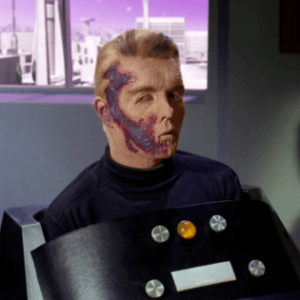
The newest addition to the Star Trek canon stars the OG space captain, Christopher Pike, shown left on Star Trek: The Original Series–the moniker offends my Trekkie eye but I bow to the will of the people–as a burned dude in a rolling iron-lung/personal-sauna contraption. (They could tune the thing to his brainwaves yet could only construct it to give yes-or-no answers? Even a Magic 8-Ball can say “maybe.” Come on now.)


It was also announced on April 5, 2022, that Star Trek: Picard will shoot a third, final season and will bring back many characters from Star Trek: The Next Generation, including Riker, Geordi, Worf, Deanna Troi, Dr. Crusher, and Data.


If you’re reading this in 2063, Happy First First Contact Day! If you see some people with pointy ears, don’t shoot!


copyright notice 2022 Worldwide Weird Holidays 2022

Share this:

November 23 is TARDIS Day

On November 23, 1963, the BBC aired the first episode of its new science fiction series about a mysterious man and his time machine. (Why did it look like a British police box? Because its chameleon circuit jammed after it landed in 1960s England, of course.)

TARDIS DayNo one could have predicted that Doctor Who would go on to be the longest-running science fiction television show in history. The original pilot was deemed unwatchable, scrapped and reshot, delaying the premiere by a week.

By the time the retooled episode, An Unearthly Child, made it to air on November 23, 1963, it was overshadowed by the assassination of President Kennedy, which had occurred the day before.

But Doctor Who eventually found an audience, especially after the introduction of the Daleks. More than half a century later, it is still popular with millions of loyal viewers. William Hartnell was the First Doctor to hop aboard the TARDIS, which stands for Time and Relative Dimension in Space.

From the start, it was established that a Gallifreyan Time Lord can only regenerate twelve times. That would have made Peter Capaldi the last. Some fans insist the rule was nullified during Matt Smith’s tenure. Others maintain that John Hurt’s character was the forgotten regeneration between Paul McGann and Christopher Eccleston, which meant Capaldi was the Thirteenth Doctor.

The debate was settled by Chris Chibnall, the show’s new head writer, who announced, “After months of lists, conversations, auditions, recalls, and a lot of secret-keeping, we’re excited to welcome Jodie Whittaker as the Thirteenth Doctor.

“I always knew I wanted the Thirteenth Doctor to be a woman and we’re thrilled to have secured our number one choice.” The canon-busting series 11 began on October 7, 2018, and, while a few continued to cavil about the heresy of a female Doctor, fans voted with their eyeballs.

According to the UK Broadcasters’ Audience Research Board (BARB), which includes online viewership, 10.9 million people watched the premiere, the highest number for a season opener since the show’s return in 2005. BARB also reported that more girls than boys under 16 watched the debut: 378,000 vs 339,000. Last season’s first episode drew 143,000 girls and 339,000 boys. Brilliant.

We celebrate TARDIS Day because Doctor Who continues to entertain us with its steadily expanding universe, at once strange and strangely familiar. It’s also created a legion of Whovians, fans who seek each other out, bond over their love of the show and debate about who is the best Doctor, the worst villain, or even how many Doctors Who there have been.

Find some great ways to celebrate TARDIS Day here. Find the Doctor Who episode that fell on (or closest to) your birthday on Tardisday.com. Catch up on recent (2005-present) seasons on Amazon Prime. Watch the classics (1963-1989) when you sign up for BritBox. Fair warning: Even without the 97 lost episodes discarded by the BBC in the 1970s, there are more than 700 episodes, making it impossible to watch them all during a seven-day free trial period. Unless you’ve figured out that whole wibbly-wobbly, timey-wimey situation, in which case, enjoy!

Happy TARDIS Day!

Copyright © 2018 Worldwide Weird Holidays