
Posts

National Buy a Book Day

National Buy a Book Day Worldwide Weird Holidays

Today is National Buy a Book Day, created in 2010 by author Philip Athans to support bookstores, writers and the publishing industry. He chose September 7 as the date of its observance because it falls on his birthday.

Athans described his inspiration in science fiction/fantasy blog Grasping at the Wind:

It started with a tweet, which warned of more layoffs ahead at Borders. I know a few people there, and one of them told me, “I’m only speculating, but I really think that unless Borders has a huge holiday sales run, they’ll be looking at bankruptcy by the early part of next year. I hope I’m wrong. And unless things change, it wouldn’t surprise me if B&N shares the same fate in a few years.”

As we now know, Borders did indeed file for bankruptcy protection on February 16, 2011. The next day it began to liquidate 226 of 511 stores, laying off 6,000 employees. On July 19, 2011, it announced layoffs of 10,700 and liquidation of the remaining 399 stores; the last closed on September 18, 2011.

David Magee of the International Business Times had this to say in 2011:

So many customers liked to flip through some books, maybe even buying one every now and then. But Borders stores occupied 25,000 square feet on average, and it’s hard to make a profit renting some of America’s prime real estate at that level when people primarily enjoy looking at the only product you have to sell.

In other words, bookstores in America have become more park-like for many consumers than action-oriented book buying spots…The stores would have been great if they were truly park-like, with government subsidies filling in for the lack of profit…

It’s sad, yes. It’s also the reality of this day. Bookstores have become park-like for many, a place to relax and look. But active buying is required to keep them open.

These gentlemen’s dire predictions edge ever closer to becoming reality. Get out there today, find a store that sells books: paperbacks, hardcovers, even books of daily affirmations will do, if you must. Athans suggests buying a book written by a living author so they can profit from the sale.

Feel free to post the title of the book you bought—or the book you’ve written—in the comments. We’re lacing up our sneakers now to embark on our own quest.
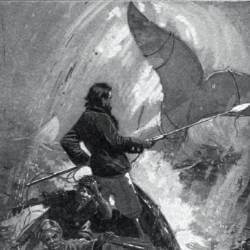
Moby-Dick Marathon

moby-dick marathonThe 24-hour Moby-Dick Marathon begins at noon today at the Mystic Seaport in Mystic, CT.
An actor portraying Herman Melville will recite the novel’s first chapter aboard the Seaport’s 1841 wooden whaler. Visitors can sign up to read a chapter aloud.

Hopefully, the reading will progress at a pace that will bring it to a conclusion at noon on August 1st, when revelers will celebrate the 206th anniversary of Melville’s birth and enjoy a tasty slice of great white cake.

While everyone is welcome to bring a picnic or purchase a meal at one of the museum’s restaurants, no food or drink, except bottled water, will be allowed on board the historic ship.

Happy Moby-Dick Marathon and happy birthday (just a bit early) to Herman Melville!

National Simplicity Day

national simplicity dayJuly 12, 2025, is the 208th anniversary of author and consummate liar Henry David Thoreau’s birth. His name is held in high regard, and his work evokes a fondness and nostalgia in readers and inspirational-quote-mongers.
Thoreau’s account of his retreat into nature and the wisdom it brought him is largely fictional. At Worldwide Weird Holidays, we’re okay with that. We ask only that publishers stop classifying this stuff as memoir. Call it a novel.

Then maybe we can all stop trying to live up to an impossible standard that he didn’t even try to reach. Any pompous ass can say profound things when his mom’s on the way over to cook dinner.

*****

National Simplicity Day honors the birthday, on July 12, 1817, of Henry David Thoreau, author, ersatz ascetic, armchair philosopher, and navel-gazing misanthrope.

Thoreau famously went to live in a cabin in the woods, the better to ponder life without the inconvenience of other people and the irritations of everyday, well, life.

In Walden, or, Life in the Woods, he wrote, “I frequently tramped eight or ten miles through the deepest snow to keep an appointment with a beechtree, or a yellow birch, or an old acquaintance among the pines.”

Thoreau certainly could turn a phrase; many of them clog the arteries of inspirational sites and satisfy the sweet tooth of quote-mongers who reverently offer them up on posters, mousepads, and coffee mugs.

He neglected to mention that the area was always bustling with people. A commuter train passed nearby. He hosted parties. He lived a twenty-minute walk from his parents’ house and made the trip several times a week to enjoy his mother’s cooking.

The man who advised his readers to eat only one meal a day to avoid indulging base appetites was visited by his mother and sisters at least once a week to bring him food, tidy up the cabin, and clean his laundry.

Let’s be clear. We don’t fault the man for entertaining, eating well, and having the women in his family help him. The problem is that he wrote as if he were roughing it in the middle of nowhere, with no one but the trees and forest creatures for company. He then used that fictitious narrative to promote an ideology he never practiced.

If Thoreau couldn’t or wouldn’t “unplug” in the 1850s, how can we expect his philosophy to succeed for us today? And who says we should even try? After all, the Unabomber actually lived in a cabin by himself for many years, and his manifesto included instructions for living off the grid. Upon further investigation, we found that he also received support from his family.

Exhortations to simplify one’s life can be helpful, but they often mask disdain and smug superiority. Thoreau reminds us of the intrepid explorer in a documentary, ostensibly forging a path that was trodden moments before by the cameraman walking backward in front of him.

Have a happy National Simplicity Day! But if you can’t keep it simple, don’t worry – you’re in good company.

July 10 is Clerihew Day

clerihew day

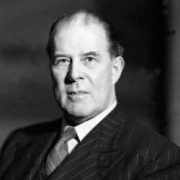
Edmund Clerihew Bentley

Today is Clerihew Day, a holiday that celebrates the birthday of British author and journalist Edmund Clerihew Bentley (July 10, 1875 – March 30, 1956), who invented the purposefully silly type of rhyming verse that bears his middle name.

A clerihew consists of four lines in AA, BB rhyming couplets. (The first and second lines rhyme with each other; the third rhymes with the fourth.) According to legend, Bentley constructed the first clerihew as a schoolboy, regarding Sir Humphry Davy, a British chemist who discovered several chemical elements.

Sir Humphry Davy
Abominated gravy.
He lived in the odium
Of having discovered Sodium.

To which we would like to add:

We’re not sure why Davy
couldn’t stomach gravy.
Was it his fault?
Did he add too much salt?

One of our favorite clerihews comes from X.J. Kennedy’s Famous Poems Abbreviated:

Once upon a midnight dreary,
Blue and lonesome, missed my dearie.
Would I find her? Any hope?
Quoth the raven six times, “Nope.”

Here’s our challenge to you, dear reader:

Why not compose a clerihew?
If you enjoy it, write a few.
Soon you will be called a poet
But none will say you didn’t know it.

Have a happy Clerihew Day!