Posts

Pink Flamingo Day

pink flamingo day

Today is Pink Flamingo Day, founded on June 23, 2007, by Mayor Dean Mazzarella of Leominster, Massachusetts, to honor the 50th birthday of the iconic lawn ornaments that have happily survived despite homeowners’ associations’ attempts to hunt them to extinction.

In 1957, art school graduate Don Featherstone was tasked with creating a pink flamingo for his employer, Union Products, located in Leominster, often referred to as the “Plastics Capital of the World.” Using National Geographic photographs as reference material, Featherstone sculpted two pink flamingos. They were meant to be a festive way for homeowners to personalize the identical yards of postwar suburban subdivisions.

Featherstone would go on to create 750 items for Union Products and become the company’s president in 1996. His flamingos were popular but eventually became a target of derision, a symbol of tackiness. Many fans remain loyal in defiance of their neighbors’ plot to eradicate them under the guise of lawn beautification. (If we’re going there, let’s talk about how many seasonal flags a community needs.)

No history would be complete without mentioning John Waters and his 1972 movie, Pink Flamingos. An enthusiastic proponent of all things kitsch, camp, and lowbrow, Waters helped bring the decoration to a new audience, one that reveled in irony. It’s clear that pink flamingos continued to sell. So many knockoffs were produced that in the late 1980s, Featherstone added his signature to the molds to identify the real thing.

Featherstone retired in 2000. Union Products closed its doors in 2006, after producing more than 20 million flamingos. Cado Company in Fitchburg, MA, bought the rights a few years later and now manufactures birds with the inventor’s signature on the bottom.

Featherstone passed away on June 22, 2015, at the age of 79, one day shy of the 28th annual Pink Flamingo Day. Claude Chapdelaine, VP at Cado, told Boston Magazine,: “He was just a really nice guy, never took himself seriously. Throughout his career, he made all kinds of lawn and garden ornaments. A lot of people referred to them as being kind of kitsch. He said, ‘You know what? It makes people laugh and brings a smile to everybody’s face’ and that’s what he liked.”

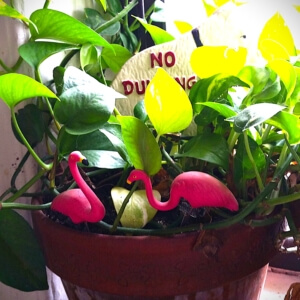
Bring a smile to everybody’s face today by planting some pink flamingos of your own. If you have some already, display them prominently: no hiding them behind shrubbery allowed! Even if the closest thing you have to a yard is a plant on your windowsill, there’s always room for these Lilliputian versions.

pink flamingos planted in houseplant

Happy Pink Flamingo Day!

Share this:

June 10 is the Banana Split Festival

June 10, 2026, marked the 32nd annual Banana Split Festival. Behind the scenes of this sweet celebration, a battle has raged for years between the citizens of two All-American towns.

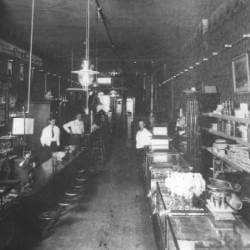
Each year, the festivities honor Ernest Hazard of Wilmington, Ohio, who concocted the treat in 1907 to attract Wilmington College students to his establishment.

He halved a banana, added three scoops of ice cream, topped each with chocolate syrup, strawberry jam, or pineapple bits, sprinkled ground nuts on top, covered it in whipped cream, and added two cherries for good measure. He later brainstormed the name with a cousin.

banana split festival

Hazard’s Cafe, Wilmington, OH

In June 1995, the people of Wilmington created the Banana Split Festival to commemorate Hazard’s invention. It’s been celebrated every year since.

However, in August 2004, residents of Latrobe, Pennsylvania, announced that pharmacist David Strickler had invented the dessert at Tassel Pharmacy in 1904, three years before Hazard. The town instituted its own Great American Banana Split Celebration, pegged to the 100th anniversary.

The National Ice Cream Retailers Association (NICRA) certified Latrobe as the birthplace of the banana split. Food historian Michael Turback, author of The Banana Split Book, agreed, although he was unable to find any hard evidence, such as newspaper clippings on which to base his decision.

banana split festival

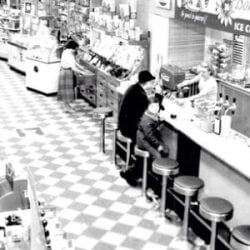
Tassel Pharmacy, Latrobe, PA

“Soda fountains were very competitive,” Turback explained of the opposing claims.  “They were always trying to outdo each other, to see who had the most elaborate sundaes.”

While Wilmington, Ohio, and Latrobe, Pennsylvania, continue to duke it out for dessert dominance, the real winners are banana split fans who have not one, but two events to celebrate their love for a whole lot of ice cream with a little bit of fruit.

Ohio’s festival features live music, pony rides, a petting zoo, a baseball tournament, a 5K run, and a banana split eating competition (no hands allowed!). However, the featured attraction every year is a “make your own banana split” booth. Yum!

Happy Banana Split Festival! (And don’t worry: you’ll get another chance to celebrate in August!)

Share this:

June 7 is VCR Day

vcr day

Ampex VRX-1000, 1956

Today is VCR Day. It commemorates the date in 1975 when Sony Corporation supposedly released the Betamax videocassette recorder (VCR) made specifically for home use. Some historians place the release in November 1975. In any case, it beat JVC’s Video Home System (VHS) to market by a year.

A VCR records the analog audio and video of a television broadcast or other signal source onto a removable, magnetic tape videocassette for subsequent playback. A programmable timer allows the user to schedule the recording to initiate, run, and conclude while unattended. It can also play back prerecorded tapes.

The history of the VCR dates back to the Ampex VRX-1000, which was released in 1956. Due to its substantial size and prohibitive cost of $50,000, it was affordable only to television networks and the largest individual stations. Toshiba, Philips, and RCA joined the fray; Sony partnered with Ampex for a while to share technology.

In 1965, Sony introduced the reel-to-reel type CV-2000, which stands for Consumer Video, as its first home-use model. (One ad shows the price as $695.) Despite Sony’s marketing efforts, it was primarily used for medical and industrial applications. Companies jockeyed for position for another decade.

There are many theories about why Sony won the battle to beat JVC to market in 1975, only to lose the war. One irrefutable fact is that each videocassette format was compatible only with its own VCR, ensuring that VHS and Betamax would never be able to play nice.

Sony may have gambled on its customers’ desire for quality over quantity, offering higher-definition tapes that could only record up to one hour of programming. While we value that today, it was much less of a selling point in 1975, when simply being able to record a show and watch it was more of a priority than being able to parse every speck of dust on M*A*S*H in hallucinatory detail.

When JVC released its VCR a year later, it used VHS tapes that held two hours. By the time Sony caught up, it was too late. VHS had become the standard. In 1981, Betamax had only a 25% market share. By 1986, it had dropped to 7.5% and continued to decline. Although it began selling VHS recorders in 1988, Sony continued to manufacture Betamax recorders until 2002 and only stopped producing Betamax tapes as of March 2016.

Of course, VHS didn’t stay on top forever. JVC stopped manufacturing standalone VCRs in 2008, long after DVD and Blu-Ray players had supplanted them. Streaming services put another nail in the VCR’s coffin.

Can a direct neural interface be far behind? As long as it doesn’t require the skull drilling we see in science fiction movies and the monthly fee is good, we say bring it on!

Until then, let’s celebrate our technological past and have a happy VCR Day!

Share this:

Heimlich Maneuver Day

June 1st is Heimlich Maneuver Day. You may think you know everything you need to know about this procedure and the man who may or may not have invented it. But, stick around because this one gets weird.

In 1974, the journal Emergency Medicine published Dr. Henry Heimlich’s article about a method to combat choking that has saved countless lives.

heimlich maneuver day 1

At the time, a series of blows to the back was the treatment of choice. Thoracic surgeon Heimlich said he set out to find a better way and realized that when choking, air is trapped in the lungs. When the diaphragm is elevated, the air is compressed and forced out along with the obstruction.

He anesthetized a beagle to the verge of unconsciousness, plugged its throat with a tube, then conducted experiments to find an easy way to get the dog to expel it. After succeeding, he reproduced the result with three other beagles.

Refined for use on humans, his technique entails standing behind the choking person, making a fist below the sternum but above the belly button, and pulling it in and up to dislodge the blockage.

In 1976, the Heimlich maneuver became a secondary procedure to be used only if back blows were unsuccessful. In 1986, the American Heart Association (AHA) revised its guidelines, recommending the Heimlich maneuver as the primary option for rescuers.

heimlich maneuver day

Heimlich was a fierce proponent of using the procedure to rescue drowning victims, but the AHA warns it can lead to vomiting, aspiration pneumonia, and death.

But his most controversial theory is “malariotherapy,” the practice of infecting a patient with malaria to treat another ailment. Although he had no expertise in oncology, Heimlich was convinced it could treat cancer.

In 1987, after the Centers for Disease Control (CDC) refused to supply him with infected blood, he went to Mexico City and convinced the Mexican National Cancer Institute (MNCI) to allow him to treat five patients with malariotherapy. Four of the patients died within a year. The project was abandoned with no follow-up studies.

In 1990, The New England Journal of Medicine published Heimlich’s letter proposing malariotherapy as a treatment for Lyme disease. Before long, sufferers around the world began to ask for the treatment. But lack of supporting evidence and poor patient reviews spelled the end of the exercise.

Within a few years, he decided it could tackle AIDS. Anthony Fauci, Director of the National Institute for Allergy and Infectious Diseases (NIAID), labeled the idea “quite dangerous and scientifically unsound.” However, Heimlich was able to secure financing from Hollywood donors and establish a clinic in China.

In 1994, his Heimlich Institute paid four Chinese doctors between $5,000 and $10,000 per patient to inject at least eight HIV patients with malarial blood. At the 1996 International Conference on AIDS, he announced that in two Chinese patients, CD4 counts that decrease as HIV progresses to AIDS, had increased after malariotherapy and remained elevated two years later.

When experts reviewed the studies, they found that the test used by Chinese doctors to measure CD4 levels was notoriously unreliable, rendering the results useless. Heimlich pressed on, but this time had a difficult time finding sponsors.

In 2005, Heimlich determined that a rebranding was in order. Reasoning that the word “malaria” might scare people off, he changed the name to “immunotherapy.” When speaking to a journalist, he refused to disclose the exact location of his latest clinical trial in Africa. Due to its ethically dubious practice of initially denying treatment for malaria, the study had been conducted without governmental permission.

That same year, the AHA undertook a de-branding effort: its guidelines no longer refer to the Heimlich maneuver by name. It is now simply referred to as an “abdominal thrust.” Since 2002, Heimlich’s son Peter has worked to pierce the myth surrounding his father, labeling him a fraud and exposing alleged human rights abuses, including experimentation on unwitting people in violation of international ethical standards regarding informed consent.

On Monday, May 23, 2016, the 96-year-old reportedly performed his maneuver on 80-year-old Patty Ris, a fellow resident at Deupree House, a senior living community in Cincinnati, Ohio. He told a reporter it was the first time he’d used his invention to save a life. (In 2003, he told BBC Online News that he’d saved someone at a restaurant three years earlier.) While many news outlets reported it as fact, some came to question its veracity.

While it’s an understatement to say that Dr. Henry Heimlich was a complex and problematic individual, there is no denying that he created a life-saving procedure. Unless he didn’t. According to emergency room physician Edward Patrick, he helped develop the maneuver before Heimlich took sole credit and slapped his name on it.

Patrick’s backstory is bizarre, including a possible scam involving “saving” a girl from drowning to help Heimlich convince the AHA to recommend it. (As mentioned earlier in the post, AHA rejected it. And in reality, the girl slipped into a coma and died four months later.)  We’re not saying any of this is true, of course. Along with every other allegation, Patrick is allegedly quite litigious.

However you decide to celebrate it, have a happy day free of the need for the Heimlich maneuver!

Share this: