Posts

August 26 is Women’s Equality Day
women's equality dayToday is Women’s Equality Day, created in 1972 to commemorate the date in 1920 whenafter decades of effort by activists across the country, the 19th Amendment to the U.S. Constitution was ratified, granting women the right to vote.

Fifty years later, on August 26, 1970, feminist Betty Friedan led a nationwide protest called the Women’s Strike for Equality to demand the fair treatment of women in the workplace, in school and at home.

U.S. Representative Bella Abzug championed the establishment of a day to symbolize the rights that women (and men) had struggled to make a reality.

On August 26, 1972, the first Women’s Equality Day took place. The Joint Resolution of Congress reads:

Designating August 26 of each year as Women’s Equality Day
WHEREAS, the women of the United States have been treated as second-class citizens and have not been entitled the full rights and privileges, public or private, legal or institutional, which are available to male citizens of the United States; and
WHEREAS, the women of the United States have united to assure that these rights and privileges are available to all citizens equally regardless of sex; and
WHEREAS, the women of the United States have designated August 26, the anniversary date of the certification of the Nineteenth Amendment, as symbol of the continued fight for equal rights: and
WHEREAS, the women of United States are to be commended and supported in their organizations and activities,
NOW, THEREFORE, BE IT RESOLVED, the Senate and House of Representatives of the United States of America in Congress assembled, that August 26th of each year is designated as Women’s Equality Day, and the President is authorized and requested to issue a proclamation annually in commemoration of that day in 1920, on which the women of America were first given the right to vote, and that day in 1970, on which a nationwide demonstration for women’s rights took place.

In 1981, Congress enacted Public Law 97-28, designating the week beginning March 7, 1982, as Women’s History Week. President Ronald Reagan issued Presidential Proclamation 4903 stating, in part:

NOW, THEREFORE, I, RONALD REAGAN, President of the United States of America, do hereby proclaim the week beginning March 7, 1982, as Women’s History Week. Recognizing that the many contributions of American women have at times been overlooked in the annals of American history, I encourage all citizens to observe this important week by participating in appropriate ceremonies and activities planned by individuals, governmental agencies, and private institutions and associations throughout the country.

The practice continued until 1987 when, in response to petitioning by the National Women’s History Project, Congress passed Public Law 100-9 declaring March Women’s History Month. It passed a new resolution each year asking the president to authorize the observance. Since 1995, Presidents Clinton, Bush, Obama and *cough* Trump have issued annual proclamations renewing Women’s History Month.

The month was chosen because International Women’s Day falls on March 8th, despite the fact that the 1908 garment workers’ strike it was meant to memorialize didn’t happen on that date. The first known International Women’s Day gathering in the U.S. took place at New York’s Carnegie Hall on February 27, 1910.

In 2011, Representative Carolyn Maloney introduced a bill calling for the establishment of Susan B. Anthony Day honoring the birthday on February 15, 1820, of the abolitionist and suffragette. Thus far, it is observed in only five states. No national holiday honors any woman’s birthday.

Equal Pay

On June 10, 1963, President John F. Kennedy signed the Equal Pay Act. Its stated purpose: “to prohibit discrimination on account of sex in the payment of wages by employers engaged in commerce or in the production of goods for commerce.”

In 1963, women made 59 cents on average for every dollar earned by men, based on Census figures of median wages of full-time, year-round workers.

On July 2, 1964, President Lyndon B. Johnson signed the Civil Rights Act, after pushing it through Congress to fulfill the plan Kennedy made before he was assassinated. It outlawed discrimination based on race, color, religion, national origin or gender.

In April 1996, the National Committee on Pay Equity (NCPE) originated National Equal Pay Day to promote public awareness of the gap between men’s and women’s wages. Each year, a date is chosen in April to illustrate how far into the new year women have to work to earn the same wages that men make in the previous year. In 2016, April 16 was chosen.

According to the US Congress Joint Economic Committee, a woman earns 80 cents for every dollar a man is paid for the same job. This statistic doesn’t tell the whole story, though. Black women make an average of 62 cents and Latinas earn 54 cents for every dollar paid to a white, non-Hispanic man. At this rate, the pay gap won’t close until 2059, according to the Institute for Women’s Policy Research.

Happy Women’s Equality Day! Perhaps when we’re equal every day of the year we won’t need to create any more holidays to celebrate it.

Copyright © 2017 Worldwide Weird Holidays

May 24 is International Tiara Day

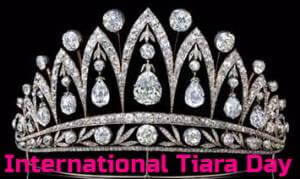
international tiara dayToday is International Tiara Day, created in 2005 by Barbara Bellissimo as a one-time accompaniment to her self-improvement program, Seasons of Success.

In 2008, Lynanne White of American Rose Bridal asked for and received Barbara’s permission to make International Tiara Day an annual tradition. When she discovered May 24, 1819, had been Queen Victoria’s birthday, she decided to keep the date as is.

Since 2009, May 24th has given every woman in the world who secretly dreams of being a princess the opportunity to don an obviously fake, bedazzled headband–or, in the case of Kate Middleton and Queen Elizabeth, a priceless, jewel-encrusted symbol of divine rule.

Why not go gender-neutral? Princes wear crowns, too! So put on your physical or metaphorical tiaras, everybody, and have a happy International Tiara Day!


Share this:

March 31 is National “She’s Funny That Way” Day

Today is National “She’s Funny That Way” Day. Its purpose is to pay tribute to the women who make us laugh all year long.

national she's funny that way dayAuthor Brenda Meridith created today’s holiday to coincide with the March 2003 publication of her coming-of-age novel entitled She’s Funny That Way.
There are many ways to celebrate: watch comedic movies and TV shows, catch a stand-up act in person or online, read humorous essays and books, or just call up the funniest woman you know and laugh until you run out of minutes.

Here is a partial list of women who crack us up:

  • Julia Louis-Dreyfus
  • Amy Schumer
  • Ilana Glazer
  • Abbi Jacobson
  • Jenny Slate
  • Natasha Leggero
  • Chelsea Peretti
  • Lena Dunham
  • Whitney Cummings
  • Jessica Williams
  • Sarah Silverman
  • Cameron Esposito
  • Samantha Bee
  • Melissa McCarthy
  • Tina Fey
  • Amy Poehler
  • Kristen Schaal
  • Eliza Coupe
  • Casey Wilson
  • Lisa Kudrow
  • Jen Kirkman
  • Iliza Schlesinger
  • Tymberlee Hill
  • Danielle Schneider
  • Lisa Lampanelli

We know we’ve overlooked many hilarious ladies/women/girls/females/goddesses. If you feel there’s been a miscarriage of justice, by all means, let us know. Write your suggestions in the Comments section and we’ll add them to the list. (We’ll give you proper credit, of course.)

While we understand that humor is subjective and some material might be considered offensive, we will not remove anyone from the list. We don’t present ourselves as the ultimate arbiter of taste and trust our readers to keep their own counsel regarding what they choose to watch and read.

Have a happy National “She’s Funny That Way” Day!

Copyright © 2017 Worldwide Weird Holidays

February 15 is Susan B. Anthony Day

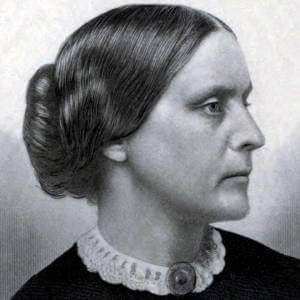
Susan B. Anthony DayToday is Susan B. Anthony DaySusan Brownell Anthony, born February 15, 1820,  was an American abolitionist and feminist who fought for women’s rights, including the right to vote, until her death in 1906.

The only weird thing about this holiday is that it is officially observed in only five states: Wisconsin, Florida, West Virginia, New York, and California.

Anthony’s father believed his daughters should get a good education and sent her away to study. When she returned at age 14—when women weren’t allowed to attend college—she took one of the few jobs deemed acceptable: teaching. She earned $2.50 a week while her male counterparts earned $10.00. She felt equal work deserved equal pay.

At that time, married women were required to give their wages to their husbands. Wives were property, as were their children. Any inheritance a wife received automatically belonged to her husband as well. Only single women could enter into contracts. Women, regardless of marital status, were not allowed to vote on social and political issues that affected their lives.

In 1840, Elizabeth Cady Stanton and Lucretia Mott, two women who would later become Anthony’s compatriots, were turned away and not allowed to speak against slavery at the World Anti-Slavery Convention in London—because they were women.

In 1848,  Mott, Stanton, and others held a historic meeting in Seneca Falls, NY, where they issued a Declaration of Sentiments and Resolutions, detailing the disenfranchisement of women. It’s widely believed that Anthony met Stanton and Mott there.

In fact, she was not introduced to the two women until 1851. According to Lisa Tetrault, author of The Myth of Seneca Falls: Memory and the Women’s Suffrage Movement, 1848-1898, this misperception was encouraged by Anthony and Stanton to depict a unified movement, with the 1840 incident leading directly to the Seneca Falls “watershed moment” for the cause of women’s equality.

In actuality, there were many divisive issues. Some wanted to prioritize African-American male suffrage above white women’s suffrage. Splinter groups formed in support of free love, tax resistance, temperance, and social purity. Many African-American women participated while also fighting to improve working conditions for freedwomen.

There’s no arguing that Susan B. Anthony was an essential part of the movement. She traveled around the country, rallying women with her rousing speeches. She was known to say, “The Constitution says, ‘We the people,’ not, ‘We the male citizens.'”

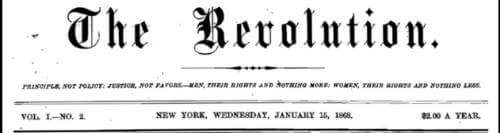
In January 1868, she and Stanton launched a weekly newspaper, The Revolution, in New York City. It focused primarily on women’s rights and suffrage, but also covered topics such as politics, finance, and the labor movement. Its motto was “Principle, not Policy—Men, their rights and nothing more: Women, their rights and nothing less.”

Susan B Anthony Day

The Fifteenth Amendment to the U.S. Constitution was ratified on February 3, 1870. It states, “The right of citizens of the United States to vote shall not be denied or abridged by the United States or by any State on account of race, color, or previous condition of servitude.”

Although it made no mention of women, Anthony decided to vote in the 1872 presidential election, arguing that she qualified as a “citizen” and was protected by the amendment. She and a group of other women were arrested after voting in her hometown of Rochester, NY. A trial was scheduled for early the following year.

Prior to 1878, federal courts barred criminal defendants from testifying or addressing the jury in their own trials. Before the trial, however, they were allowed to attempt to “educate” anyone who might be selected as a juror.

According to the Federal Judicial Center, “Anthony spoke in twenty-nine villages and towns of Monroe County, asking ‘Is It a Crime for a U.S. Citizen to Vote?’ When she delivered her lecture in Rochester, the county seat, a daily newspaper printed her speech in full, circulating it further.

In May, after many delays, U.S. Attorney Richard Crowley successfully petitioned to have the trial moved to a neighboring county, negating Anthony’s efforts to persuade the jury pool. She immediately drew up a schedule to visit every town she could in the month before her trial on June 17, 1783.

A jury of twelve men and Justice Ward Hunt listened to Crowley’s prosecutorial arguments for the better part of the day. Anthony’s defense attorney Henry Selden presented his case during the latter part of the afternoon.

The following day was devoted to Crowley’s recitation of the government’s case. At the end of the day, Justice Hunt declared that Anthony had knowingly violated the law and that, as a result, there was nothing for the jury to determine; it must return a verdict of guilty.

Selden argued for the jury’s right to decide guilt or innocence and its need to determine Anthony’s intent when voting. Hunt again told the jury it must deliver a guilty verdict, and the clerk refused to allow Selden to poll the jury.

Selden returned to court the next day to file a motion for a new trial. In circuit courts, a motion was heard by the same judge whose actions had caused an attorney to file that motion. In other words, Justice Hunt would be asked to decide whether he had violated the Constitution by denying Anthony a trial by jury.

Unsurprisingly, Hunt denied the motion, stating that the right to a trial by jury “exists only in respect of a disputed fact,” and no facts were in dispute. Before sentencing her, Hunt asked Anthony if she had anything to say.

She responded with perhaps the most impassioned speech in the history of the fight for women’s rights, offering a blistering indictment of everything from the trial to male sovereignty to the responsibility to disobey unjust laws, such as those that had made it illegal to give a cup of water to a fleeing slave. (Transcript here.)

She condemned the proceedings she said “trampled under foot every vital principle of our government.” She had not received justice under “forms of law all made by men,” “failing, even, to get a trial by a jury not of my peers.”

Sentenced to pay a $100 fine and the costs of the prosecution, she swore to “never pay a dollar of your unjust penalty.” In a move calculated to preclude an appeal to a higher court, Hunt ended the trial by announcing, “Madam, the Court will not order you committed until the fine is paid.”

She continued to agitate, traveling to almost every state, speaking publicly at each stop. It’s been estimated that, in 60 years of tireless effort to win women the right to vote, she gave 75 to 100 speeches per year.  She served as president of the National American Woman Suffrage Association (NAWSA) from 1892 to 1900 and continued to fight until her death on March 13, 1906, at the age of 86.

The Nineteenth Amendment to the U.S. Constitution was ratified on August 18, 1920. It states, “The right of citizens of the United States to vote shall not be denied or abridged by the United States or by any state on account of sex.”

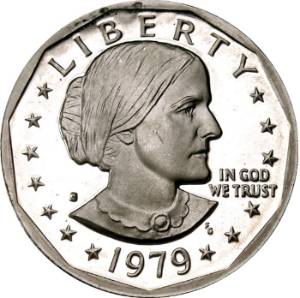
In 1979, the U.S. Mint introduced the Susan B. Anthony dollar, the first coin to bear the likeness of an American woman. We think she would have found it funny to be enshrined on federal money…

 Susan B. Anthony Day

…since she never paid that fine.

Copyright © 2017 Worldwide Weird Holidays