Posts

National Simplicity Day

national simplicity dayJuly 12, 2025, is the 208th anniversary of author and consummate liar Henry David Thoreau’s birth. His name is held in high regard, and his work evokes a fondness and nostalgia in readers and inspirational-quote-mongers.

Thoreau’s account of his retreat into nature and the wisdom it brought him is largely fictional. At Worldwide Weird Holidays, we’re okay with that. We ask only that publishers stop classifying this stuff as memoir. Call it a novel.

Then maybe we can all stop trying to live up to an impossible standard that he didn’t even try to reach. Any pompous ass can say profound things when his mom’s on the way over to cook dinner.

*****

National Simplicity Day honors the birthday, on July 12, 1817, of Henry David Thoreau, author, ersatz ascetic, armchair philosopher, and navel-gazing misanthrope.

Thoreau famously went to live in a cabin in the woods, the better to ponder life without the inconvenience of other people and the irritations of everyday, well, life.

In Walden, or, Life in the Woods, he wrote, “I frequently tramped eight or ten miles through the deepest snow to keep an appointment with a beechtree, or a yellow birch, or an old acquaintance among the pines.”

Thoreau certainly could turn a phrase; many of them clog the arteries of inspirational sites and satisfy the sweet tooth of quote-mongers who reverently offer them up on posters, mousepads, and coffee mugs.

He neglected to mention that the area was always bustling with people. A commuter train passed nearby. He hosted parties. He lived a twenty-minute walk from his parents’ house and made the trip several times a week to enjoy his mother’s cooking.

The man who advised his readers to eat only one meal a day to avoid indulging base appetites was visited by his mother and sisters at least once a week to bring him food, tidy up the cabin, and clean his laundry.

Let’s be clear. We don’t fault the man for entertaining, eating well, and having the women in his family help him. The problem is that he wrote as if he were roughing it in the middle of nowhere, with no one but the trees and forest creatures for company. He then used that fictitious narrative to promote an ideology he never practiced.

If Thoreau couldn’t or wouldn’t “unplug” in the 1850s, how can we expect his philosophy to succeed for us today? And who says we should even try? After all, the Unabomber actually lived in a cabin by himself for many years, and his manifesto included instructions for living off the grid. Upon further investigation, we found that he also received support from his family.

Exhortations to simplify one’s life can be helpful, but they often mask disdain and smug superiority. Thoreau reminds us of the intrepid explorer in a documentary, ostensibly forging a path that was trodden moments before by the cameraman walking backward in front of him.

Have a happy National Simplicity Day! But if you can’t keep it simple, don’t worry – you’re in good company.
July 11 is Cheer Up the Lonely Day

cheer up the lonely day

So close. Find the correct quote below, courtesy of quoteinvestigator.com.

Today is Cheer Up the Lonely Day, created by Francis Pesek of Detroit, Michigan. His daughter L.J. Pesek described him as “a quiet, kind, wonderful man who had a heart of gold.”

“He got the idea as a way of promoting kindness toward others who were lonely or forgotten as shut-ins or in nursing homes with no relatives or friends to look in on them.” She said he chose July 11 because it was his birthday.

What is the definition of the word lonely?
ˈlōnlē/ adjective
  1. sad because one has no friends or company.
    “lonely old people whose families do not care for them”
    • without companions; solitary.
      “passing long lonely hours looking onto the street”
    • (of a place) unfrequented and remote.
      “a lonely stretch of country lane”

The elderly can become isolated as their circles of friends grow smaller due to the illness and death of their contemporaries. They may be relocated to facilities at the fringes of their communities. Loss of physical mobility makes it a struggle to visit others; losing autonomy after lives spent caring for themselves and others takes a psychological toll that can result in depression.

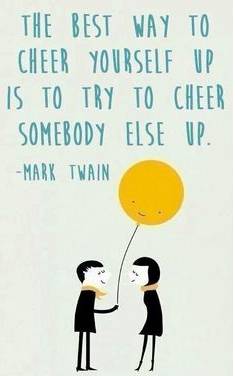
Mark Twain once wrote, “The best way to cheer yourself is to try to cheer somebody else up.” There’s no denying that time spent face-to-face with loved ones, telling them how much they mean to us, does our hearts good. We also know what it’s like to be lonely. It can happen in the middle of a crowd. It only takes a moment to be kind to a stranger today.

Have a happy Cheer Up the Lonely Day and remember how good it feels. That way, we can keep it going tomorrow and every day after that.

July 10 is Clerihew Day

clerihew day

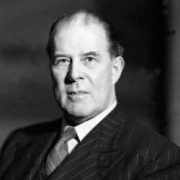
Edmund Clerihew Bentley

Today is Clerihew Day, a holiday that celebrates the birthday of British author and journalist Edmund Clerihew Bentley (July 10, 1875 – March 30, 1956), who invented the purposefully silly type of rhyming verse that bears his middle name.

A clerihew consists of four lines in AA, BB rhyming couplets. (The first and second lines rhyme with each other; the third rhymes with the fourth.) According to legend, Bentley constructed the first clerihew as a schoolboy, regarding Sir Humphry Davy, a British chemist who discovered several chemical elements.

Sir Humphry Davy
Abominated gravy.
He lived in the odium
Of having discovered Sodium.

To which we would like to add:

We’re not sure why Davy
couldn’t stomach gravy.
Was it his fault?
Did he add too much salt?

One of our favorite clerihews comes from X.J. Kennedy’s Famous Poems Abbreviated:

Once upon a midnight dreary,
Blue and lonesome, missed my dearie.
Would I find her? Any hope?
Quoth the raven six times, “Nope.”

Here’s our challenge to you, dear reader:

Why not compose a clerihew?
If you enjoy it, write a few.
Soon you will be called a poet
But none will say you didn’t know it.

Have a happy Clerihew Day!

July 8 is the Soapy Smith Wake

Today is the 43rd annual Soapy Smith Wake. Since 1974, descendants of con man Jefferson “Soapy” Smith have held an annual wake for him on the anniversary of his murder in Skagway, Alaska, on July 8, 1898.

soapy smith's wake

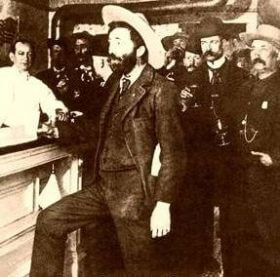
Soapy Smith, image at legendsofamerica

Jefferson Smith lived to prove the axiom, “A fool and his money are soon parted.” He gained his nickname due to his prize soap scam, in which he’d set up a display of soaps, make a show of placing bills from one to one hundred dollars around several bars, wrap them to resemble the other bars, then appear to hide them in the stack.

A shill he’d plant in the crowd would pay a dollar, unwrap a seemingly random soap, pull out a bill, and start shouting about his winnings. This convinced others to clamor to buy the other bars. There were no more winners. Smith had used sleight of hand of hand to conceal the fact that he had not put the money-wrapped bars in the pile. Halfway through, he announced the hundred-dollar bill hadn’t yet been found and auctioned off the remainder.

At some point in Smith’s mostly successful twenty-year career, Smith was arrested for running the prize soap racket. The police officer forgot Smith’s first name and wrote “Soapy Smith” in his logbook. The name stuck.

Smith’s luck came to an end on July 8, 1898, after his crew bilked a miner out of a sack of gold in a crooked game of three-card monte. Four men, including vigilante Frank H. Reid, confronted Smith, who refused to return the gold or turn over his associates. In the ensuing gunfight, Smith and Reid exchanged fire. Smith was shot through the heart and died instantly; Reid, shot in the groin, died twelve days later of his injuries.

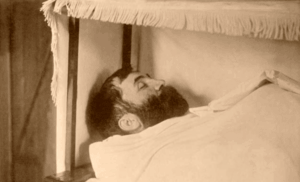
Soapy Smith, dead, image at legendsofamerica

Soapy Smith was buried several yards outside the Skagway city cemetery. Over the years, his reputation grew to that of a Klondike-style Robin Hood, fleecing the rich to give to the poor. There’s no evidence he did anything but line his own pockets and those of the public servants and businessmen he bribed.

Reid was painted as a villain who murdered Smith. If we assume the two men shot each other—and there are those who question that—then Smith must have shot Reid first, since he couldn’t have fired after being shot through the heart. Unless the gun went off as he was falling, but then we’re getting into grassy knoll territory.

On July 8, 1974, members of Smith’s family and their friends began the tradition of holding a wake at his gravesite, toasting him with several bottles of champagne. When the group felt nature calling, they started another tradition by entering the cemetery proper and relieving themselves on Frank H. Reid’s grave.

A reporter present at the wake dubbed it the “sprinkling of Frank.” The Smiths and many residents found it humorous at the time. The family continued to furnish champagne for years until the wake was finally banned from the cemetery and moved to the Eagles Hall in downtown Skagway.

If you can’t make it to Skagway to celebrate, The Magic Castle in Hollywood, California, has held a Soapy Smith Party every year since 2004. No matter where you are, raise a glass, if you like, and toast the cantankerous, thieving criminal known as Soapy Smith. And if you have to pee, please use a restroom.