Posts

International Accounting Day

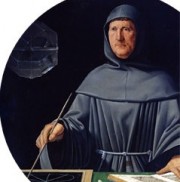
international accounting day pacioliWhat’s so exciting about International Accounting Day? On November 10, 1494, Italian mathematician and Franciscan friar Luca Bartolomeo de Pacioli published “Summa de Arithmetica, Geometria, Proportioni et Proportionalita” (Everything About Arithmetic, Geometry and Proportion).

It included a detailed description of double-entry bookkeeping, called the Method of Venice. Although this technique had been practiced for centuries, Pacioli’s treatise was the first of its kind in print and earned him the title of “Father of Modern Accounting.”

*****

Many in modern times have followed in Pacioli’s footsteps, with varying degrees of success.

Chuck Liddell is a former UFC Light-Heavyweight Champion whose fighting skills have helped make mixed martial arts a mainstream sport. He is also a trained accountant, with a BA in Business and Accounting from California Polytechnic University. No one will be making any “boring bean counter” jokes to him.

Kenny G. is a world-famous saxophonist whose smooth jazz sounds have sold more than 75 million records worldwide. He also graduated magna cum laude from the University of Washington with a degree in accounting, which he credits with helping him manage his finances early on in his career and paving the way for future success.

John Grisham earned a degree in accounting, intending to become a tax attorney. Instead, he decided to pursue a career in criminal law. His first novel, A Time to Kill, was based on evidence he observed at trial. He has written 47 books, 10 of which have been made into movies, and has sold over 300 million copies in print. (Fun fact: Grisham wrote a comedic novel, Skipping Christmas, which was made into the movie Christmas with the Kranks!)

In 1962, Mick Jagger was studying accounting and finance — on scholarship — at the London School of Economics when he formed the Rolling Stones with Keith Richards and Brian Jones. We think you’ll agree that it worked out for the best.

*****

Need more proof that accounting is cool? Click here to apply for a job at the FBI! According to FBI.gov:

The Forensic Accountant (FoA) role is one of the most vital and sought-after careers
in the Federal Bureau of Investigation (FBI). Forensic accountants use their accounting
skills, auditing, and investigative techniques to research and follow the systems through
which money may be funneled or laundered by terrorists, spies, and criminals involved in
financial wrongdoing.

How many are there, exactly? We could tell you, but then we’d have to kill you. (Not really; we just don’t know.)

Happy International Accounting Day!

International Tongue Twister Day

Today is International Tongue Twister Day. Celebrate with these doozies chosen for their fun and difficulty. Will they leave you speechless? Read aloud and repeat, if you dare.

international tongue twister day twisted tongueIn 2013, researchers at the Massachusetts Institute of Technology (MIT) tripped up volunteers with the following word combination, which they declared the most difficult tongue twister in the English language.

Pad kid poured curd pulled cod.

It was judged to be even harder to say than a longstanding favorite introduced in 1990 by American expert (and MIT graduate) William Poundstone:

The seething sea ceaseth and thus the seething sea sufficeth us.

Guinness World Records stopped monitoring the category after 1974, when it gave the following sentence its highest marks:

The sixth sick sheikh’s sixth sheep’s sick.

What are the elements of a tongue twister? Our brains can handle words that sound identical, like “I scream, you scream, we all scream for ice cream.” It’s the same story with words that sound very different from each other, such as “How much wood would a woodchuck chuck if a woodchuck could chuck wood?”

At a meeting of the Acoustical Society of America in San Francisco, CA, the MIT team presented findings that different types of tongue twisters have distinct effects on our brains, lips, tongues, and throats as we produce speech errors.

Our brains get drawn up short when we attempt to jump between two nearly identical sounds, confusing one sound with the other. “She sells seashells on the seashore” twists the tongue because the sss and shh sounds are similar but not exactly the same. Speech errors also occur when we try to repeat certain words or phrases quickly. For instance,  “toy boat” several times in a row turns into “toy boyt,” while “top cop” becomes “cop cop.”

Insight into such slip-ups may help researchers understand how humans process and plan speech. As we speak, we must coordinate movements of the lips, tongue, jaw, and larynx. Our brains may sort sounds by which muscles need to move to produce them, such as front-of-the-tongue sounds (sss), back-of-the-tongue sounds (ga), and lip sounds (ma).

“This implies that tongue twisters are hard because the representations in the brain greatly overlap,” Edward Chang, a neuroscientist at the University of California, told Nature.

Invite some people over for an International Tongue Twister Day party and have fun trying to say some of these whoppers.

Rubber baby buggy bumpers
I saw a kitten eating chicken in the kitchen.
Lesser leather never weathered wetter weather better.

Here’s a little tongue twister trivia to amaze your friends.

We all know this Mother Goose nursery rhyme:

Peter Piper picked a peck of pickled peppers;
A peck of pickled peppers Peter Piper picked;
If Peter Piper picked a peck of pickled peppers,
Where’s the peck of pickled peppers Peter Piper picked?

But did you know that it was inspired by the life of one-armed Frenchman Pierre Poivre? An 18th-century horticulturist and pirate, Poivre raided spice stores and smuggled the seeds back to France. Poivre often stole nutmeg seeds, which were nicknamed “peppers.”

Another famous tongue twister was taken from a song written in 1908.

She sells seashells by the seashore;
The shells she sells are seashells, I’m sure.
So if she sells seashells by the seashore,
I’m sure she sells seashore shells.

Terry Sullivan’s ditty paid tribute to Mary Anning, whose father taught her to find and dig fossils from the cliffs of Lyme Regis in Dorset, England. As an adult, she famously unearthed a previously unknown type of dinosaur, later named Plesiosaurus.

Which do you like? Which one is the hardest to say? Should a nonsense phrase like “pad kid poured curd pulled cod” be considered a tongue twister, or is it cheating? What do you think?


Global Handwashing Day

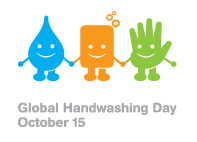
Today is Global Handwashing Day. We know, we know: eww! When it comes to that ill-advised hot dog wolfed at a highway rest stop, we are all like Mulder on the X-Files: we want to believe. That counter’s clean, the food freshly prepared by people who treat every day as handwashing day. So this must be one of those silly, made-up holidays. Right? Why are we still talking about this?global handwashing dayGlobal Handwashing Day was founded in 2008 by the Global Public-Private Partnership for Handwashing to raise awareness of how proper hygiene can prevent disease transmitted by hand.  Here’s a tweet promoting the holiday, along with its embedded graphic.
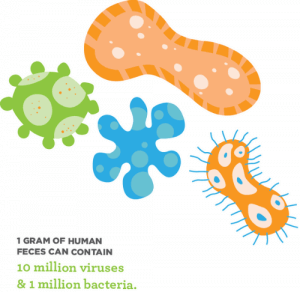
Why #GlobalHandwashingDay? B/C 1 trillion germs can live in 1 gram of poop (abt weight of a paper clip)! https://bit.ly/1JUaOrD

global handwashing feces facts

Wait a minute. The numbers in the tweet and its graphic don’t match. Although I think we can all agree that either number is unsettling, we feel it’s our duty to get to the bottom of this. Who knew that researching this would end up in such a dark place?

Okay, now that we’ve gotten our juvenile punning (mostly) out of the way, let’s learn a little bit about the strangers in our poop. According to a study cited by the Centers for Disease Control, a gram of feces can contain a total of 1 trillion germs. So the tweet is right. Reporting of the number of viruses and bacteria, however, varies wildly. You might want to take our word for it. The Google search alone will make you want to douse yourself in hand sanitizer (which, by the way, isn’t as effective as you’d think.)

Now that you’ve got a face full of feces facts, here’s a dollop more. A German site called my.microbes aims to be the first social network to connect members with similar microbial profiles to “share experiences, remedies, health and diet tips.” Watch out, Match.com! [2025 Update: Since I wrote this in 2015, this German site has been so well scrubbed and/or buried that the only mention I found on Google is my cross-post on sister site Magick Sandwich. I had to resort to the Wayback Machine to prove this site was real. No BS!]

If you’ve got your mind on your manure and your manure on your mind, track your output with the Poop Log app. According to the developer, he updated it to include the ability to attach photos because “it is the most requested feature from my users.” Poop Log allows you to track your bowel movements using the Bristol Stool Scale. [In 2015, this was the only poop tracking app we could find. Ten years later, there are at least fifteen offered on Google Play. A healthy deposit, in our opinion.]

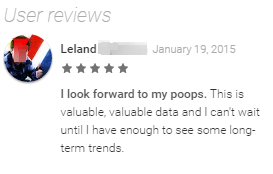
The Bristol Scale was devised in England and is very, well, descriptive. Click here to view it, but maybe not when you’re eating sausage. We’re not showing it here because we don’t want to support poop porn. We will show you this enthusiastic review of PoopLog, though:pooplog review Leland, we wish you the best in your turd analysis. Perhaps the Poop Map would be a useful app for you, too. Just a quick word of advice: turn off the flash when you take a shelfie™* in a public place, which we fervently hope is a restroom. The uninformed might frown on you taking a photo of what came from your posterior for posterity.

Now, if you’ll excuse us, we’re going to go wash our hands. We may never stop.

*sh– + selfie: don’t make us spell this out

International Skeptics Day

Reality is that which, when you stop believing in it, still exists.
Philip K. Dick

international skeptics day

I’m not sure how he’d feel about International Skeptics Day since there’s no evidence that it’s an official holiday anywhere. Considering the number of skeptical organizations worldwide, perhaps it should be.

The sticklers among us might point out that Skeptics Day is also listed in some quarters as occurring on January 13.

Others might say the dearth of critical thinking calls for as many reminders of the need for skeptical inquiry as possible.

Perhaps the weirdest thing about this holiday is that we seem to need it at all.

To learn more:

  • Watch the YouTube channel of the James Randi Foundation. Many tried and failed to win Randi’s years-long Million Dollar Challenge, which promised the prize to anyone who could show proof of the paranormal. The challenge ended in 2015, the money unclaimed.
  • Plumb the resources of the Committee for Skeptical Inquiry.
  • Find like-minded skeptics in your neighborhood at meetup.com.
  • Consult Snopes.com, the Web’s Google search for hoaxes and misinformation, before you forward that chain email about how the government is poisoning us all with cheese.
  • Watch an old episode of Mythbusters, a show that made testing urban legends entertaining. (After the series wrapped, it became clear that the biggest myth was that the two hosts got along.)
  • Read A Practical Guide to Critical Thinking, which is sure to help you resist that midnight infomercial, win an argument, and separate fact from fiction in almost any situation.

No matter how or when you choose to celebrate International Skeptics Day, have fun!