weird and wacky holidays happening in December

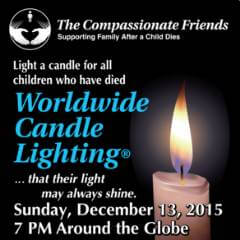
Worldwide Candle Lighting

Worldwide Candle LightingThe Worldwide Candle Lighting ceremony is held each year on the second Sunday of December. It was created by The Compassionate Friends (TCF), a non-profit organization that assists grieving families.

Stephen Simmons, a chaplain at England’s Warwickshire Hospital, founded TCF in 1969. After bringing together two sets of grieving parents, he realized the support they gave one another was better than anything he could provide.

The group grew as word of it spread around the globe. In 1978, it crossed the ocean and was incorporated in Illinois. The first Worldwide Candle Lighting took place there in 1997. 

The annual observance unites family and friends to remember sons, daughters, brothers, sisters, and grandchildren gone too soon. Participants light candles from 7:00 to 8:00 p.m. local time.

Considered the largest mass candle lighting on the planet, the Worldwide Candle Lighting produces a virtual 24-hour wave of light as it moves from one timezone to the next. Hundreds of formal events are conducted while thousands of families meet in private to honor the memories of departed loved ones and express gratitude for the time they shared.

TCF and allied organizations are joined by local bereavement groups, churches, funeral homes, hospitals, hospices, children’s gardens, schools, cemeteries, and community centers. Services have ranged in size from just a few people to nearly a thousand.

If no Worldwide Candle Lighting service was held near you last year and you’d like to hold one, TCF invites you to use its Suggestions to Help Plan a Memorial Service in Conjunction with The Compassionate Friends Worldwide Candle Lighting© to help you organize an event. Submit the information to the TCF website so it can add your service to the many others held in the U.S. and around the world.

The Worldwide Candle Lighting encourages bereaved families everywhere to “light a candle for all children who have died…that their lights may always shine.”

Copyright 2016 Worldwide Weird Holidays

December 10 is Dewey Decimal Day

dewey decimal dayToday is Dewey Decimal Day. Melville Louis Kossuth Dewey was born on December 10, 1851, in the hardscrabble town of Adams Center in Northern New York State. At the age of 22, while studying at Amherst College in Boston, he devised one of the most efficient methods of classification ever known, copyrighting the Dewey Decimal System three years later in 1876. He’s proven to be much harder to classify.

Dewey abhorred waste, championing conversion to metric measurements and the use of streamlined phonetic spellings. Upon leaving home, he shortened his name to Melvil and attempted to change his last name as well, but admitted defeat when his bank refused to recognize his new signature. Otherwise, we’d be referring to the Dui Decimal System right now.

Many libraries at that time utilized a numbering system that indicated the floor, aisle, section and shelf upon which each book was stored. When rearrangement became necessary, all of the books had to be reclassified. Dewey was determined to devise a simple, workable, permanent classification system.

He formulated a system of Arabic numerals with decimals for book classification. All printed knowledge would be organized into ten numerical classifications ranging from 000 to 900, with as many decimals as necessary to define the content of the book being classified.

Within three years, A Classification and Subject Index For Cataloguing and Arranging the Books and Pamphlets of a Library was published. It was widely adopted in the United States and England as well as elsewhere in the world. This system has proven to be enormously influential and remains in widespread use.

In 1883, Dewey was recruited by Columbia University to become its librarian. The following year, he founded the School of Library Economy—the first school for librarians ever organized. It opened on January 5, 1887. He personally enrolled each student. Of the twenty-six, nineteen were women.

Columbia forbade admittance to females. Since Dewey believed that women were destined to become librarians, he ignored this rule. That didn’t make him a feminist, though. His enrollment questionnaire required an applicant to report her height, weight, hair and eye color. Inclusion of a photograph was strongly recommended.

In spite of the school’s financial success, Columbia shuttered it the following year and Dewey moved on, accepting an invitation to become director of the New York State Library in 1883. In 1895, he founded a private resort in Lake Placid, New York, and began to campaign for the Olympic Games to be held there. Ten years later, Dewey was forced to resign as State Librarian after complaints that his Lake Placid Club denied entrance to smokers, drinkers, blacks and Jews.

In 1926, he moved to Florida to establish a new branch of the resort. He died on December 26, 1931, in Lake Placid, Florida. The following year, Lake Placid, New York, hosted the Winter Olympics.

Turns out Dewey was more complicated than his system.

Copyright 2016 Worldwide Weird Holidays

Official Lost and Found Day

official lost and found dayOfficial Lost and Found Day was created in 2012 to encourage people to seek out things they’ve lost. The holiday became “official” three years later when it was recognized by Chase’s Calendar of Events. It is always observed on the second Friday of December.

Collecting lost things in a central location is nothing new. The practice was documented on papyrus in ancient Greece and Rome. Japan’s system dates back to a code written in 718 A.D. that called for severe punishment of those who failed to turn over items they’d found. In 1733, two officials who kept a parcel of clothing were paraded through town and then executed. (Thankfully, the law was reformed in the late 19th century.)

In 1805, Napoleon ordered the establishment of a place “to collect all objects found in the streets of Paris.” In 1893, the city began to actively try to track down the owners. While the policy is still in force, it’s estimated that only one in four lost belongings finds its way back to its original home.

In the course of its history, the Paris Lost and Found has received five human skulls, a 17th-century saber, World War I helmets, muzzle-loading pistols, a Victorian Era tripod and telescope, two floor-length wedding dresses and two chunks of masonry from the World Trade Center site.

Transport for London’s lost property office opened in 1934 and collects about 130,000 objects each year, ranging from  obvious items like mobile phones and wallets to more unusual ones like kitchen sinks, urns filled with ashes, false teeth, prosthetic limbs, wheelchairs and breast implants.

How can we “find” the meaning of Official Lost and Found Day? Founder Lance Morgan explains:

Official Lost and Found Day is a day for renewed hope and belief that lost items should never be forgotten or abandoned to lost and found limbo.  Please take a moment on Official Lost and Found Day to make one more effort, one more leap of faith, that what you’ve lost isn’t gone, it’s just not conveniently handy.  Reach out, make a call, stop by the office, retrace your steps.  What was lost can be found. It’s up to you.

At Worldwide Weird Holidays, we’re going to start by looking between the sofa cushions. Even if you don’t find a thing, have fun looking and we think you’ll find yourself having a happy Official Lost and Found Day!

Copyright 2016 Worldwide Weird Holidays

Share this:

Tio de Nadal

Some homes hang stockings from the mantelpiece. Families in Catalonia, Spain, celebrate the run-up to Christmas by placing a Tió de Nadal in front of the fireplace. Although Tió de Nadal translates most wholesomely to “Christmas log,” it is better known by the name Caja Tió, which we’re going to refer to as “Poop Log” in order to avoid offending any delicate sensibilities. Feel free to fill in the appropriate four-letter word as needed.

Tio de Nadal

Originally a simple rough-hewn piece of wood, the tió’s appearance has been upgraded in recent years. Modern iterations stand on two or even four stick legs, have a smiling face painted on the upper end and often sport a red hat.

Beginning on December 8th to coincide with the Feast of the Immaculate Conception, children must “feed” the tió bits of fruits, nuts and water, draping it in a blanket to keep it warm, in the hope that their care will awaken its spirit of generosity so it will poop out many gifts on Christmas Day.

The children’s kindness ends there. They must go into another room to pray for the poop log to deliver lots of goodies while the adults surreptitiously place gifts under the blanket. (We’re assuming the log doesn’t have magical powers.) Then the children reenter and beat on the log with sticks to make it defecate while they sing various versions of the Caga Tió song.

“Caga tió, caga torró,
avellanes i mató,
si no cagues bé
et daré un cop de bastó.
caga tió!”

S***, log, s*** nougats,
hazelnuts and mató cheese,
if you don’t s*** well,
I’ll hit you with a stick,
s*** log!

After each verse, a child reaches under the blanket and takes a gift. After opening it, the song begins again. The tió gives candies, nuts and dried fruits; larger items are believed to be delivered but the Three Wise Men. (Duh!) The log drops a herring, head of garlic or onion to indicate there is no more poop to be had. (That part may be magic. We’re not sure of logistics involved.) At that point, the beatings cease and the tió is thrown into the fire and burned.

You can’t make this s*** up.

Copyright 2016 Worldwide Weird Holidays

Share this: