
January 31 is Scotch Tape Day
Today is Scotch Tape Day and celebrates the invention of cellophane tape in 1930. The story begins in the early 1920s at Minnesota Mining and Manufacturing, now known as 3M, which made only sandpaper at the time. Richard Gurley Drew, a banjo-playing college dropout hired as a research assistant, soon changed the course of the company’s history.
 While delivering sandpaper samples to an auto body shop, Drew noticed painters’ frustration with the tape they used to mask car parts. Overly sticky, it ripped off bits of paint when removed, ruining the detail and forcing them to start over. He made it his goal to find a solution to their problem.
For the next few years, Drew experimented until he found the perfect combination of treated crêpe paper, cabinetmaker’s glue and glycerin. It adhered well yet stripped off easily without taking paint with it when removed. Automakers immediately recognized its value and began placing orders for it. The tape was marketed as Scotch Masking Tape in 1925.
Drew rose quickly through the ranks. In 1929, he struck upon the idea of using DuPont’s recently invented cellophane to make transparent tape. Cellophane was a moisture-proof material used to wrap and present baked goods and grocery items. Its only drawback was the difficulty of sealing packages securely and attractively. Drew hoped to develop tape that would blend with the wrap.
The machinery used to apply adhesive to masking tape was ill-equipped to deal with cellophane, which curled and ripped. The amber glue used on masking tape looked terrible on a transparent surface. Drew and his team had to design new machines and a new clear adhesive made from a combination of oil, rubber and resins.
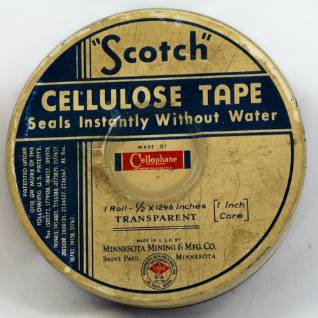
The resulting Scotch Cellulose Tape was introduced in 1930. By that time, DuPont had already developed a new type of cellophane that could be sealed with heat, negating the need for tape. Despite the fact that Drew’s invention missed its target market and debuted during the Great Depression, the adhesive tape sold well to thrifty customers.
In fact, the desperate times may have spelled success for Scotch tape when other products would have failed. Even the racial slur the name is supposedly based on may have helped boost its sales. Scottish people were considered stingy. It was an ethnic stereotype that served 3M well: when money is scarce, stinginess is a virtue and a “cheap” product is a smart buy.
3M later promoted the legend with ads featuring “Scotty McTape,” a cartoon mascot who repeated the story that in 1925, auto painters told a 3M rep (presumably Drew) to go back to his “Scotch” bosses and tell them to put adhesive all over the tape. That’s unlikely since 3M didn’t make tape at the time and, in any case, the problem for the painters was that the adhesive was too strong.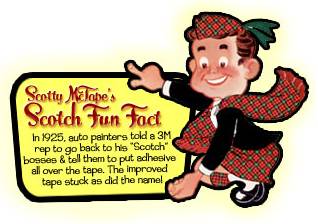
Soon Scotty McTape was declared a member of Clan Wallace and began wearing its red tartan (and Wallace Hunting green plaid.) In the early 1970s, it was decided that McTape was no longer an effective marketing tool and the character was retired. The casual racism of Scotch tape’s name has been forgotten. Dispensers decorated in plaid are purchased every day with no awareness of their association with the clan of William Wallace, also known as Braveheart.
Richard Drew died in 1980 and was posthumously inducted into the Inventors Hall of Fame for U.S. patent number 1,760,820. While working for a sandpaper manufacturer, he invented a tool that has become an essential part of our lives. The next time you reach for adhesive tape, at home or the office, take a moment to imagine life without it. We can’t but, thanks to Mr. Drew, we don’t have to.
Happy Scotch Tape Day!

 The 2017 American Fancy Rat and Mouse Show scheduled on January 28th has been canceled due to an outbreak of Seoul virus infection, a member of the Hantavirus family of rodent-borne illness, in the Midwest.
 Today is National Opposite Day. Then again, maybe not. Many sources quote many other sources that claim it occurs on January 25th each year. We would never repeat such a vague assertion.