Posts

Krampus

KrampusOn Santa’s List Day, we suggested that children who learn the list of who’s naughty and nice has been finalized might be tempted to misbehave in the remaining days before Christmas, with no fear of reprisal. Krampus, today’s holiday, should thoroughly dispel that notion.

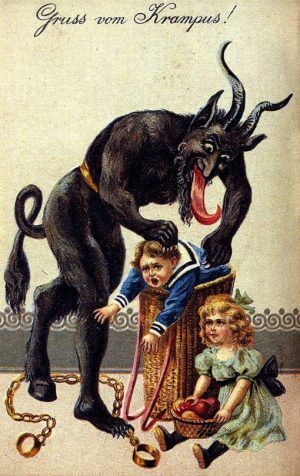
Krampus may have originated as a pagan figure in Europe’s Alpine regions, becoming associated with St. Nicholas in the 17th century. The word Krampus derives from the Old High German word for “claw” (Krampen). He is a goat-headed devil with fangs, a pointed tongue, and two cloven hooves or one hoof and one human foot.

Unlike the Santa Claus of North American tradition, St. Nicholas pays attention only to good children. He brings Krampus along on his rounds to deal with little miscreants for whom receiving a lump of coal is the least of their worries. He carries chains, birch branches, or a whip to mete out punishment and sometimes a sack or basket to capture bad children so he can drown them, eat them, or deliver them to Hell.

Europeans have been exchanging greeting cards featuring Krampus for two centuries. Greetings from Krampus (Gruß vom Krampus) cards feature humorous verse and depict the devil looming over children or pursuing buxom women. Modern cards tend to have a cuter, less menacing version of Krampus.

Although its tastefulness and propriety have been questioned over the past century, the holiday’s popularity has grown; celebrations have cropped up across North America, including Toronto, Dallas, Philadelphia, and Washington, DC. We assume that the successful completion of chores has skyrocketed in those towns.

Happy Krampus!

Share this:

Start Your Own Country Day

Today is Start Your Own Country Day. According to legend, it was introduced at the 1939 World’s Fair in New York City to honor “those free-spirited souls who dared to hope and believe in a better world where they too could declare any land their own.”

start your own country

We’ve been unable to confirm that account. No matter its origin, Start Your Own Country Day promotes awareness that, within certain parameters, it is possible to form a micronation.

That might sound appealing to anyone who is unhappy about the outcome of, say, a recent election, but doesn’t want to move to Canada because it’s too cold up there, and packing is a miserable task.

But there is more involved than not paying taxes and designing a fun yet meaningful flag. The new nation must provide and maintain roads, power, emergency services, sewage treatment, waterworks, telecommunications infrastructure, and Internet service.

The 1933 Montevideo Convention on the Rights and Duties of States declared that a nation requires four things to exist: a permanent population, a defined territory, a government, and the capacity to enter into relations with other states.

Let’s take a look at two people who’ve pursued their dreams of telling the whole world, “You’re not the boss of me!”

The Republic of Kugelmugel

start your own country day

The lack of building permits for the construction of a spherical house turned Edwin Lipburger from an artist into a dissident and the president of his one-person nation, bordered on all sides by Vienna, Austria, yet independent of it. The house itself contained the country of Kugelmugel and its sole inhabitant.

Lipburger was eventually convicted and sentenced to prison for refusing to pay taxes and, among other things, for printing his own stamps. Public sympathy for the artist persuaded the Austrian president to pardon him and halt the demolition of his house.

Lipburger now lives in exile in Vienna, while his structure has been relocated to the nearby Wiener Prater amusement park, where it has become a tourist attraction. Though barbed wire surrounds the Republic of Kugelmugel, it is still possible to get a glimpse of the spherical nation by looking through the fence.

The Principality of Hutt River

start your own country

Prince Leonard Casley seceded from Australia on April 21st, 1970, founding the Principality of Hutt River as part of an agricultural protest. The sovereign state claimed to pay no taxes but donated an equivalent sum to the Australian government each year, which apparently didn’t care what Leonard wrote in the memo line as long as it got the check. The kingdom lasted 50 years.

Like the Republic of Kugelmugel, the Principality of Hutt River issued its own stamps. It also minted coins, printed banknotes, and sold commemorative teaspoons, cufflinks, postcards, magnets, tie clips, letter openers, and other items, many of which can still be found online on eBay and CoinsNB.

What this nation had going for it was its size. Situated 595 kilometers north of Perth, it covered about 75 square kilometers — 18,500 acres — of land, roughly the size of Hong Kong. Even if the UN didn’t recognize the country’s presence, Google did. The Principality of Hutt River was one of the few micronations to appear on Google Maps. (As of this writing, it still does. Shh, don’t tell Google!)

Visitors paid a small fee and had their passports stamped upon arrival. Prince Leonard said he hosted thousands of tourists each year. Reviewers described Hutt River’s campground accommodations as “rustic.” Despite its closure, TripAdvisor still rates it “#620 of 2,913 things to do in Western Australia,” which doesn’t seem like a ringing endorsement for tourism in the area. Luckily, nearby Kalbarri offers river cruises and whale watching as a balm for adventurers who’ve driven 30 kilometers on a dusty road in search of a micronation only to arrive at a locked gate and dirt as far as the eye can see.

The story of the realm’s end is a sad one. Leonard abdicated the throne in favor of his son Graeme in 2017 and passed away in 2019 at the age of 93. Eighteen months later, Graeme dissolved the principality. Per its official website:

In June 2017, the West Australian Supreme Court ruled against Prince Leonard following litigation initiated by the Australian Taxation Office, which asserted that Prince Leonard owed a substantial sum. After Prince Leonard’s passing, it became evident that the ATO intended to foreclose and sell the land to recover the claimed debt.

In August 2020, HRH Prince Graeme declared that, after consulting with the Casley Royal Family, due to the prevailing circumstances all Principality staff and assets would be relocated, and the land returned to agricultural use in Western Australia.

Kugelmugel and Hutt River aside, many micronations still exist. Before you pack your bags, check out Wikivoyage, Atlas Obscura, or NomadMania, but be warned: these sites will take you down an hours-long rabbit hole if you let them. Still married to ink on paper? Micronations: The Lonely Planet Guide to Home-Made Nations is the only printed travel guide of its kind. It was published in 2006, so it pays to call ahead for current travel information before you trek to a country like Molossia, which has been at war with East Germany since 1983 and pegs its currency to the value of Pillsbury cookie dough.

If you’re feeling inspired, check out this handy online guide to starting a micronation, complete with Model Constitutional Code. Whether you choose to celebrate today by creating a new country, traveling to one, or just relaxing at home, have a happy Start Your Own Country Day!

Update: A year after we first posted about this holiday in 2017, we were cited as a source in The Times Herald [paywall-free link here]. We know a “micromention” isn’t as cool as a micronation, but we’ll take it!

Share this:

World Hello Day

world hello day

November 21st is World Hello Day, also known as Greet Ten People for Peace. It was founded in 1973 by brothers Brian and Michael McCormack, university students at the time,  in response to the Yom Kippur War.

“We wanted to do something to celebrate the importance of personal communication to preserving peace,” Michael McCormack later explained. They wrote to world leaders, asking them to support the new holiday. To date, they have received 83 letters of support from world leaders, Nobel Prize winners, authors and entertainers. Citizens in 180 countries have taken part in World Hello Day.

world hello day

Kofi Annan

Anyone can participate in World Hello Day. The McCormack brothers’ goal was that everyone say hello to ten strangers to encourage dialogue, understanding and friendship between people of diverse backgrounds.

world hello day

Gene Roddenberry

Around the globe, people use World Hello Day as an opportunity to express their desire for unity and peace.  With a simple greeting, they send a message to leaders, encouraging them to use diplomacy rather than force to settle conflicts. The occasion helps each person realize he or she is an instrument of change and can contribute to creating a more inclusive society.

Each time you say hello to a stranger, your heart acknowledges over and over again that we are all family. — Suzy Kassem

Happy World Hello Day! Get out there and say hi to some friends you haven’t met yet.

Share this:

Hobbit Day

Today is Hobbit Day, the longest-runniHobbit Dayng holiday celebrated by fans of J.R.R. Tolkien’s Middle Earth Cycle books, The Hobbit and Lord Of The Rings. It originated in 1973 after Tolkien’s death on September 2 of that year.

It honors the birthdays of characters Bilbo and Frodo Baggins, which occurred on the same date in 2890 and 2968, respectively. There is some disagreement among readers about the specific date.

The Gregorian calendar would place it on September 14, but Tolkien once stated that the Shire calendar is ahead by about ten days, depending on the month.

In 1978, the official date of the Long Awaited Party was fixed as September 22 by the Tolkien Society, which also happens to fall one day after  was published on September 21, 1937.

It is part of Tolkien Week, observed on the calendar week containing Hobbit Day. Festivities around the globe include feasts, costume parties, reenactments, exchange of gifts and cards and fireworks.

Happy Hobbit Day!


Share this: