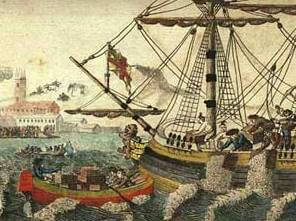
 Today is the anniversary of the Boston Tea Party. On December 16, 1773, the Sons of Liberty, disguised as Mohawks, stole aboard three British ships and emptied 342 chests of tea into Boston Harbor. This act of defiance, part of a wave of resistance throughout the colonies, was a protest against British rule. Earlier that year, Parliament had passed the Tea Act to shore up the failing East India Company.
Overall, the price of tea was lowered to undercut the prices of Dutch tea smugglers. (The colonies were legally permitted to buy tea only from the British.) However, it reaffirmed an existing three-pence-per-pound duty, one of many pieces of legislation enacted by Parliament without the input and consent of the colonies; this is often referred to as taxation without representation. The principle of self-governance, not the burden of higher taxes, motivated political opposition to the Tea Act.
The East India Company selected consignees in New York, Boston, Philadelphia and Charleston and shipped 500,000 pounds of tea across the Atlantic in September. Meanwhile, colonists held several mass meetings where it was decided to refuse the tea and send it back to England with the duty unpaid.
Under pressure from these groups, the brokers in Charleston, New York, and Philadelphia turned away the shipments. Merchants in Boston, including three relatives of the governor, refused to cooperate and allowed the ships to dock. The Dartmouth arrived on November 28th, the Eleanor on December 2nd, and the Beaver on December 15th.
Around midnight on December 16th, a large crowd gathered to watch Samuel Adams and members of Sons of Liberty board the ships. It took nearly three hours to smash open all 342 chests and dump more than 92,000 pounds of tea into the water. (The tea, by the way, was from China: Bohea, Congou and Souchong black teas, plus Singlo and Hyson green teas.) For weeks, the harbor reeked of it.
The name “Boston Tea Party” was not coined until the 1820s. It was known simply as “the Destruction of the Tea in Boston.” Many colonists, including George Washington, condemned it at the time as an act of vandalism.
Parliament saw Massachusetts as the hub of resistance to British rule and enacted laws to punish the colony in general and Boston in particular. The Coercive Acts of 1774 shut down the port of Boston until damages were paid, nullified colonial self-government in Massachusetts, declared British officials immune from criminal prosecution and required colonists to house British troops on demand.
The Acts were intended to isolate Boston and New England. The other colonies were expected to abandon them and quash any of their own ideas of insurrection due to fear of reprisal. Instead, the Acts outraged and unified the colonists, who rushed to the city’s aid, sent supplies and began to organize groups to discuss the injustice of British rule and mobilize resistance.
In September and October of 1774, the First Continental Congress convened in Philadelphia and petitioned Parliament to repeal the Coercive Acts, vowing to boycott British goods until then. Massachusetts began forming militias to defy martial law. On February 9, 1775, Parliament declared it to be in a state of rebellion.
On April 19, 1775, the first shots between British and American soldiers were fired at Lexington and Concord in Massachusetts. It is undeniable that the Boston Tea Party and Great Britain’s draconian response to it helped spark the American Revolution.
There were many other precipitating factors but the Boston Tea Party galvanized the populace and helped build a nation. It has been invoked in recent years by groups that appear to lack a working knowledge of the event. Let’s honor its place in history by treating it with the dignity and respect it deserves. (If you’d like to enjoy a cup of tea while you do, that’s fine with us.)



 Today is National Oatmeal Muffin Day. We don’t know who created it, but we do know how to celebrate it.
 Best Chocolate Chip Cookies