Posts

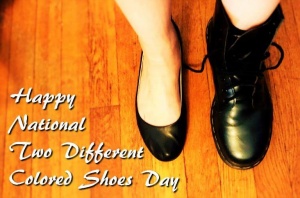
May 3 is National Two Different Colored Shoes Day

national two different colored shoes day

Today is National Two Different Colored Shoes Day, founded in 2009 by Arlene Kaiser, Ed.D., to encourage everyone to “recognize and celebrate the uniqueness and diversity of humanity.” Wearing different colored shoes is meant to demonstrate the willingness to “take a positive risk” and step outside of your comfort zone.

According to Dr. Kaiser’s biographical information, she worked as a professional actress, appearing in films, television series, and commercials, and still maintains her Screen Actor’s Guild (SAG) membership. She spent 25 years as a teacher and has earned B.A., M.A. and doctorate degrees. She’s been a professional speaker since 1979 and reports that she spoke for more than 350 service organizations before that.

She’s written numerous articles and a book used by school districts as a teaching resource. She now works as a life coach after completing a yearlong training program. She helps Scouts earn their national horsemanship-scouting merit badges, helps high-schoolers hone their competitive debate skills, and volunteers for the equestrian park patrol at county parks.

Whew! Dr. Kaiser is clearly a human dynamo. She also takes time to “walk her talk” by wearing mismatched shoes at least twice a week since the 1980s. The breadth of her experience may seem overwhelming, but she’s made her holiday both meaningful and a cinch to put into practice.

Declare your individuality: whisper it with mismatched Converse sneakers or shout it by pairing Doc Martens with a ballet slipper. (Even if they’re the same color, they will get you noticed.) Too much of a statement? That’s okay. Take some time today to tell your friends and loved ones how much you appreciate their unique qualities and gifts. Laugh at a shared memory of silliness. Make a new one.

Happy National Two Different Colored Shoes Day!

Share this:

National Kazoo Day

national kazoo day

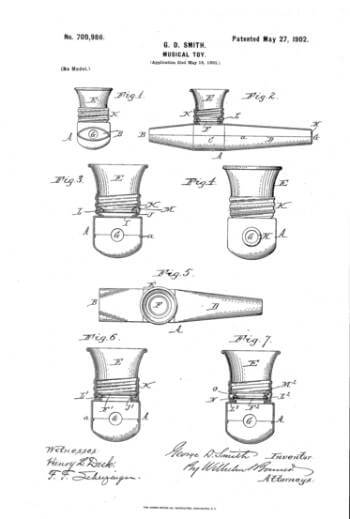
Kazoo patent, 1902

Today is National Kazoo Day, when kazoo players celebrate the long history of the instrument in America.

No one knows the exact date of the kazoo’s invention. A popular story holds that it was designed in the 1840s by an African-American man named Alabama Vest.

German clockmaker Thaddeus Von Clegg constructed a prototype, which Vest introduced at the 1852 Georgia State Fair as the “Down-South Submarine.”

The closest we can get to verifying that account is to confirm that a state fair did occur in Macon, Georgia, in 1852.

The modern metal kazoo was patented by George D. Smith of Buffalo, New York, on May 27, 1902.

We don’t know why it wasn’t mass-produced until a dozen years later. The factory, which became known as the Original Kazoo Company, now operates a museum open to kazoo fans willing to make the pilgrimage to Eden, New York.

Down south? The Kazoo Museum in Beaufort, South Carolina, opened in 2007, and has a “collection of nearly two-hundred unique kazoo-related items.” It’s located in a kazoo factory on 12 John Galt Road, an address sure to delight Ayn Rand fans.

Budding kazooists should keep in mind that the kazoo is a membranophone, which modifies the player’s voice via a vibrating membrane. Players must hum, not blow, into the kazoo, varying pitch and volume to produce different sounds.

Because no advanced musical training is required, a player can become a virtuoso almost immediately. That fact may also be what keeps the kazoo from getting the respect it deserves.

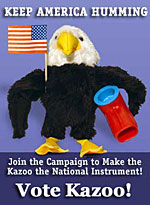
national kazoo dayKazoo virtuoso Barbara Stewart founded the “Keep America Humming Campaign to Make the Kazoo the National Instrument” to change that. As she told kazooamerica.org:

“We have a national bird, a national song, and a national debt. Why not kazoo as a national instrument?”

Why not, indeed?

In 2007, she told CBS Sunday Morning:

“It is said that pigs might be able to learn how, if they could be persuaded to kazoo before they eat it.”

Shortly before she died in 2011, Ms. Stewart broke the Guinness World Record for Largest Kazoo Ensemble when she led an audience of 5,910 at the Royal Albert Hall in a rousing kazoo performance. We wish we could have been there to hear it, even though we imagine we would have needed an aspirin or three afterward.

Have a happy, headache-free National Kazoo Day!

Share this:

February 29 is International Underlings Day

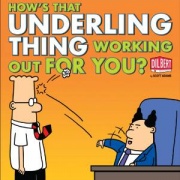
international underlings dayFeeling a little bored by Leap Day? Fear not: there is another. International Underlings Day was created in 1984 by Peter D. Morris to recognize those not honored by National Boss Day, Administrative Professional Day, Programmers’ Day, Professional Speakers Day, International Working Women’s Day—the list goes on. And on. And on.

Here’s a pop quiz to see if International Underlings Day is tailor-made for you:

Do you sometimes feel like work is a cosmic joke, that the ladder of success has a few broken rungs?

Do you know how everyone else likes their coffee, lunch, and dry cleaning?

Have you ever delivered bagels to a roomful of executives going through trust exercises?

Have you ever felt paralyzed by fear as you watched a coworker get fired for making a paperclip chain? Did you then feel:

a) relief that it wasn’t you
b) shame for feeling relieved
c) resentment that you’re still stuck in your crappy job
d) envy when you imagine that person walking around outside, free

     Have you ever quit a job, confident you would never work in such an insane asylum again, only to end up in progressively more horrifying       workplaces?

If you answered yes to any or all of the above questions, you might be an underling. Congratulations: you have a day. Unfortunately, but perhaps fittingly, that day falls on February 29th, which occurs once every four years. That makes 2020 only the tenth celebration of this holiday.

Have a happy International Underlings Day. You deserve it. Just don’t expect cake.

Copyright 2020 Worldwide Weird Holidays


January 22 is National Hot Sauce Day

national hot sauce day

Today is National Hot Sauce Day. It celebrates the birthday in 1865 of Wilbur Scoville, who created a method to determine a pepper’s spiciness that is still in use today.

Scoville, an American chemist, devised the system in 1912. It measures the concentration of capsaicin, the active component that gives chilies their spicy taste, using Scoville Heat Units (SHU). Ratings range from 0 for a bell pepper to 16,000,000 for pure capsaicin.

Capsaicin content, which causes a burning sensation when it comes in contact with any tissue, is measured by dissolving a pepper in alcohol to extract its capsaicin oil, then diluting the oil in sugar water.

If a panel of five testers detects any spiciness, the mixture is diluted again until three of the five cannot discern any hotness. Heat level is measured by how many dilutions are necessary. Every instance increases the SHU, since hotter chilies must be weakened many times for no heat to be detected.

In 2013, The Guinness World Record for hottest chili pepper went to the Carolina Reaper, a cross between a ghost pepper and a red habanero created by Ed Currie of the aptly named PuckerButt Pepper Company. The Reaper’s official heat level is 1,569,300 SHU but ranges up to 2,200,000. (By comparison, Tabasco sauce has a level 0f 2,500 to 5,000.)

The Reaper was bested in 2017 by Dragon’s Breath, which clocked in at 2,480,000 SHU. Currie surged back with Pepper X, a Frankenstein’s monster at 3,180,000 SHU. Unlike Dragon’s Breath, which will only be used for medicinal purposes, Pepper X is available as a sauce dubbed The Last Dab.

Studies have shown that heat levels evoke the same pain response in spice lovers and haters and everyone in between. So why do so many of us like it? Could it predict other risk-taking behaviors? Check out this TED Ed lesson for answers.


For some serious fun, watch The Hot Ones challenge celebrities, actors, and musicians to eat ever-hotter sauces as they chat. Dave Grohl is especially awesome. But nothing compares to okurrr’s video contrasting Lorde‘s pure enjoyment with others’ abject suffering. It’s guaranteed to make you smile.


Then buy the same sauces from Heatonist to stage your own challenge for friends or maybe people you don’t like so much. There’s even a game called Truth or Dab you can use if you’re into that retro board game kind of thing.

I went to Heatonist’s shop in NYC’s Chelsea Market and told the hot sauce sommelier–if it’s not a thing, it should be–that the only thing I couldn’t put hot sauce on was ice cream. He said, “We’ve got one for that” and turned me on to Hell Yeah, I’m Hot, a blackberry-hibiscus-habanero blend that has become my everyday yogurt topping. I’m on my third bottle.

copyright notice 2022 Worldwide Weird Holidays 2022