February 22, 2026, is the 100th World Thinking Day. It doesn’t mean we get to lay off thinking for the rest of the year. It doesn’t mean the Earth is a sentient being. What is it? Read six (very short) paragraphs to find out.
In 1899, Robert Baden-Powell wrote a field manual for fellow British soldiers called Aids to Scouting. The following year, he was declared a war hero for his bravery in conflict, and the book became well-known. It was especially popular with boys, who staged elaborate games based on his instructions about observation and tracking.
After learning of this, Baden-Powell formed the Boy Scouts in 1907. The next year, he published Scouting for Boys, a guide stressing the importance of good deeds and morality. He designed a uniform and set up a central office to register new Scouts. By the end of 1908, there were 60,000 Boy Scouts.
In September 1909, 10,000 Scouts attended the first national Boy Scout rally at Crystal Palace in London. Many girls showed up, claiming to be members. Baden-Powell founded the Girl Guides, also known as Girl Scouts in many countries, as a separate entity in 1910, eventually appointing his wife, Olave, to run it.
The Girl Scouts held its first conference in Oxford, England, in 1920. It was held every two years until 1954 and every three years since. The 39th World Conference is taking place in Cambodia.
At the fourth World Conference in 1926, delegates met at Camp Edith Macy in Briarcliff Manor, NY, a facility owned by the Girl Scouts of the USA. Participants decided to dedicate a day to reflecting on their counterparts around the world and expressing their thanks to the organization that brought them all together.
They called it Thinking Day and chose February 22 as the date for its annual observance because it was the birthday of both Robert Baden-Powell and his wife, Olave Baden-Powell. It’s since become known as World Thinking Day, and millions of girls celebrate it.
Is all this new knowledge making you crave some cookies? There’s an app for that. The Girl Scout Cookie Finder is available on iOS and Android. Who says history can’t be delicious?
Happy World Thinking Day!
Share this:
https://www.worldwideweirdholidays.com/wp-content/uploads/2017/02/WAGGGS-World-Thinking-Day-2026-World-Thinking-Day-Badges.png351351Kathleen Zeahttps://www.worldwideweirdholidays.com/wp-content/uploads/2016/04/WWWH-New-Header-2-e1501022841118.jpgKathleen Zea2026-02-22 09:05:452026-02-22 09:12:32World Thinking Day
When I first wrote about G.I. Joe Day 10 years ago, many longstanding sources declared February 1st “G.I. Joe Day.” Years later, I stumbled across a Joe superfan forum and was surprised to see that I’d been singled out as the nefarious originator of this damnable lie that went on to infect the entire Internet.
I certainly inspired some vitriol, including from a user (perhaps ironically) named “skinny,” who wrote this:
When dealing with historical facts, accuracy is important.
December 7, 1941
September 11, 2001
June 6, 1944
July 4th 1776.
Of course there are exceptions to every rule. Presidents day celebrates two Presidential birthdays on the same day. George was first so we celebrate on his Birthday. Sorry Abe.
Then there is the whole confusion about Easter so we just pick a random day in April or March.
and of course Christmas…
May the 4th is just catchy and has no significance other than cuteness to Star Wars.
However in this case we have an actual date to go by. Remember, G.I. Joe was introduced at Toy Fair in New York City on Sunday, February 9th, 1964.
Not so fast, mon frère. According to the New York Times, the American Toy Fair opened on March 9, 1964. It reported on the toy fair in its pages on March 10th, 11th, and 12th. Since I researched the archives of its printed editions, which I’m quite certain were reported contemporaneously, I’m going to give the newspaper my vote of confidence.
According to one Joe memorabilia site, a short film and prototypes were shown to prospective buyers before the fair’s opening date, but there’s no evidence that a meeting took place on February 9th. (You can watch the film here or on YouTube. Ignore the title, which misstates the toy fair as having taken place in 1963.)
So, “skinny,” it looks like we both got it wrong. In my case, though, I’m not going to compare your offense to, oh, say, getting the date of a terrorist attack wrong.
Without further ado, here is my original post. The first two sentences have been corrected. I stand by the rest.
Today is NOT G.I. Joe Day. In March of 1964, toymaker Hassenfeld Brothers (later shortened to Hasbro) introduced its first doll specifically intended for boys at the American Toy Show in New York. The company hoped to duplicate the success of Mattel’s Barbie, which had been introduced in 1959 and sold a record 351,000 units in its first year.
But there was a problem. Parents wouldn’t buy dolls for their sons. Playing with dolls was considered a girl’s activity, and boys generally wanted nothing to do with that. Some parents feared it might cause them to become effeminate and possibly even homosexual.
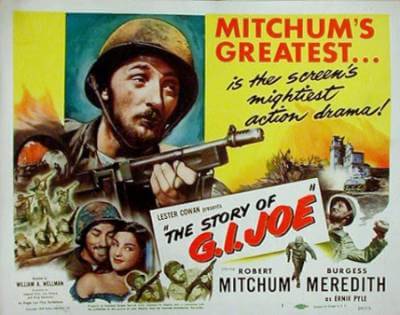
In a brilliant bit of marketing, the toymaker solved this issue by coining the term “action figure,” which has been used for countless toys since. It further masculinized the toy by making it a military man: G.I. (Government Issue) Joe. The name came from a 1945 American war film called The Story of G.I. Joe.
They also placed a scar across his right cheek. Not only did it denote manly ruggedness, combat, and valor, but it also enabled Hassenfeld Brothers to copyright the toy. (A generic human figure cannot be copyrighted.) The scar made it an identifiable character, as did a production glitch that gave Joe an inverted thumbnail.
Four original G.I. Joes were released in 1964. In June 1964, Joe was featured in LOOK magazine. An African-American soldier followed in 1965. In late 1966, the makers of “America’s Moveable Fighting Man” received a patent for its 21 points of articulation. Unlike standard toy soldiers, which were one-third the size and made of hard plastic, the Joes were fully poseable, allowing more creative play.
The Joes had been introduced while the U.S. was in the middle of an undeclared war in Vietnam. As it escalated and casualties mounted, the toys that had symbolized the brave fight against all foes, Communist and otherwise, lost their luster.
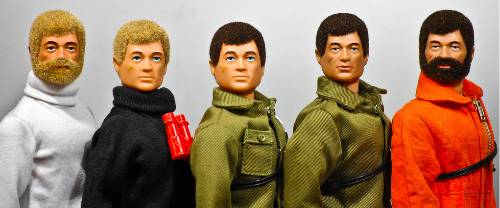
Women picketed the 1966 toy show in New York, holding umbrellas that read, “Toy Fair or Warfare?” Sears later dropped all war toys from its catalog. Fearing a boycott, Hasbro (which had shortened its name in 1968) phased out military uniforms and added flocked hair and beards. By 1970, the company had replaced the war-oriented Joe with the G.I. Joe Adventure Team.
There were individual Land, Sea, and Air Adventurer Joes, along with the more generalized Adventurer Joe and the mysterious Man of Action Joe. The kung-fu grip was born. Hasbro upped the merchandising quotient by selling props for scenes like White Tiger Hunt, Revenge of the Spy Shark, Secret of the Mummy’s Tomb, Capture of the Pygmy Gorilla, and Sandstorm Survival.
We don’t know whether kids got bored with every aspect of playtime being mapped out for them, or whether Hasbro was ahead of its time in roping parents into buying ancillary items, something that seems normal today. By 1976, the Joe brand was in trouble. Hasbro tried to cash in on the superhero craze by adding BulletMan to the lineup and throwing in a villainous caveman from outer space for good measure.
Nothing worked, and production shut down in 1978. Joe was “furloughed,” according to Hasbro, never expected to return. But the stratospheric profitability of Star Wars merchandise would give Joe one more chance. Shrunken to the same size as those action figures–a little less than 4 inches tall—Joe came back on the scene in 1982.
In an inspired feat of cross-promotion, Hasbro produced a television cartoon, G.I. Joe: A Real American Hero, as a vehicle for selling toys. It debuted as two five-part miniseries in 1983 and 1984 and ran as a regular series from 1985 to 1987. The show introduced new heroes, villains, and storylines, spawning an ever-increasing number of action figures and turning viewers into avid collectors.
Each episode concluded with a Joe teaching kids valuable lessons like “don’t go with strangers,” “don’t paint your bike in the garage,” and “blind kids can find lost kittens, too.” The kids would say, “Now we know!” and Joe would reply, “And knowing is half the battle!”
Now you know.
PS: I joined the fan forum to apologize and clarify that I hadn’t originated the date and had believed the sources that placed it on February 1st. The moderator, Jeff, wrote to me privately:
Don’t worry about it… some people are just waaayyyy serious about GI Joe and take it too far. Like skinny comparing it to 9-11… jesus.
I locked the thread because it was stupid drama.
I responded:
Thanks. I really do hate getting things wrong but I didn’t make it up. I don’t create the holidays.
As I read through the thread afterward, I saw that there was some disagreement. I assume someone chose February 1st to just get it sort of right. I don’t know who created it, so I can change the date on my blog but every other blog which has that date, most predating mine by years, will still be wrong.
Or is it right? Unless I can get to Source Perrier to find who created the holiday, I can’t know that GI Joe is actually meant to signify his “birthday” or just a general day celebrating GI Joe.
I know people take their interests very seriously. I recently incensed a square dancer by including it as a “weird” holiday. I suggested if he was sensitive, maybe square dancing is not the hobby for him.
I stand by that statement, too.
Have a happy G.I. Joe Day, whenever that may be!
Share this:
https://www.worldwideweirdholidays.com/wp-content/uploads/2016/02/GI-Joe-Day.jpg315400Kathleen Zeahttps://www.worldwideweirdholidays.com/wp-content/uploads/2016/04/WWWH-New-Header-2-e1501022841118.jpgKathleen Zea2026-02-01 12:55:512026-02-01 15:39:14February 1 is NOT G.I. Joe Day but Neither is February 9
To provide the best experience, we use technologies like cookies to store and/or access device information. Consenting to these will allow us to process data such as browsing behavior or unique IDs on this site. Denying or withdrawing consent may adversely affect certain features and functions.
Functional
Always active
The technical storage or access is strictly necessary for the legitimate purpose of enabling the use of a specific service explicitly requested by the subscriber or user, or for the sole purpose of carrying out the transmission of a communication over an electronic communications network.
Preferences
The technical storage or access is necessary for the legitimate purpose of storing preferences that are not requested by the subscriber or user.
Statistics
The technical storage or access that is used exclusively for statistical purposes.The technical storage or access that is used exclusively for anonymous statistical purposes. Without a subpoena, voluntary compliance on the part of your Internet Service Provider, or additional records from a third party, information stored or retrieved for this purpose alone cannot usually be used to identify you.
Marketing
The technical storage or access is required to create user profiles to send advertising, or to track the user on a website or across several websites for similar marketing purposes.